Manu National Park is the most biodiverse protected area on the planet by most measures, spread across southeastern Peru from Andean cloud forest down to lowland Amazon rainforest. That vertical drop is what makes it exceptional: within a single protected territory you pass through several ecological tiers, each with its own species, and a few days of travel can take you from spectacled bear habitat to macaw clay licks. It is a UNESCO World Heritage Site and draws birders, wildlife photographers and researchers from around the world.
This guide is general and informational. It explains what the park is, how it is organized, what you can realistically see, when to go and what entry requires. It is not a catalog of itineraries or a price list. Almost all in-depth nature tourism in Manu happens in one zone, the Reserved Zone, so if you already know you want to visit and you are choosing a trip, the page that covers that properly is our complete guide to the Manu Reserved Zone.
Where Is Manu National Park?
The park sits in southeastern Peru, spanning the departments of Cusco and Madre de Dios, and covers 1,716,295 ha (4.24 million acres).
What defines Manu is not size but gradient. The protected area begins on the eastern slope of the Andes, above 4,000 m (13,120 ft), and descends to the Amazon floodplain at roughly 300 m (985 ft). That descent crosses puna grassland, cloud forest, montane forest and lowland rainforest. Each tier has its own wildlife, vegetation and climate, which is why one trip can move in forty-eight hours from cock-of-the-rock leks to caiman spotting on a muddy river.
The other structural element is water. The Manu River, a tributary of the Madre de Dios, organizes the entire park. It is the access route, the axis of wildlife activity and the reason the oxbow lakes exist. Almost all tourism in Manu is built around that river.

National Park vs Biosphere Reserve: Not the Same Thing
This is the most repeated confusion in Manu research, and it is worth resolving before anything else. The Manu Biosphere Reserve is a wider designation that contains Manu National Park. It is not a synonym for it.
Manu National Park is the protected area established by the Peruvian state, with defined boundaries, an administering agency (SERNANP) and rules governing access. The Biosphere Reserve is a UNESCO designation that includes the park plus adjacent territory: buffer areas, zones of human use and communities. Put simply, all of the park lies inside the biosphere reserve, but not everything inside the biosphere reserve is national park.
This matters practically. When a figure for area, species count or population refers to “Manu”, it may describe either designation, and the difference is large. When an operator says a tour goes “into Manu”, it is worth asking which zone, because access conditions vary enormously between them. You will also see the names “Manu Amazon Park” and “Manu Jungle National Park” online: neither is an official designation and neither corresponds to any real entity.
The Three Zones of Manu
The park and its surroundings are divided into three zones with very different protection levels and access rules. This is the single distinction that decides what a Manu trip actually looks like, so we compare the three side by side, with access, wildlife, minimum days and price, in our complete guide to the Manu Reserved Zone. The short version:
Core Zone. The intangible heart of the park and the largest part of its surface. Tourist access is prohibited. Entry is limited to researchers with express SERNANP authorization and to the indigenous populations who live there, including peoples in voluntary isolation and initial contact. No operator can take you in, and anyone offering to is either misleading you or applying the word to something else. Its existence is precisely why the rest of Manu holds the wildlife it does: it works as an enormous reservoir from which animals move into the areas that can be visited.
Reserved Zone. This is where nature tourism happens inside the park, under regulated access, with quotas, mandatory guides and authorized operators. It contains the well-known oxbow lakes, the macaw clay licks and the lodges and camps that let you spend several days in primary forest. Entering is not like visiting a conventional national park: it requires a permit filed by an authorized agency and a minimum number of days, because access combines road and river travel. If your priority is wildlife, meaning giant otters, macaws at a clay lick, primates and a genuine chance at larger mammals, this is the zone you want, and the usual format is a multi-day trip such as our 6-day Manu Reserved Zone trip.
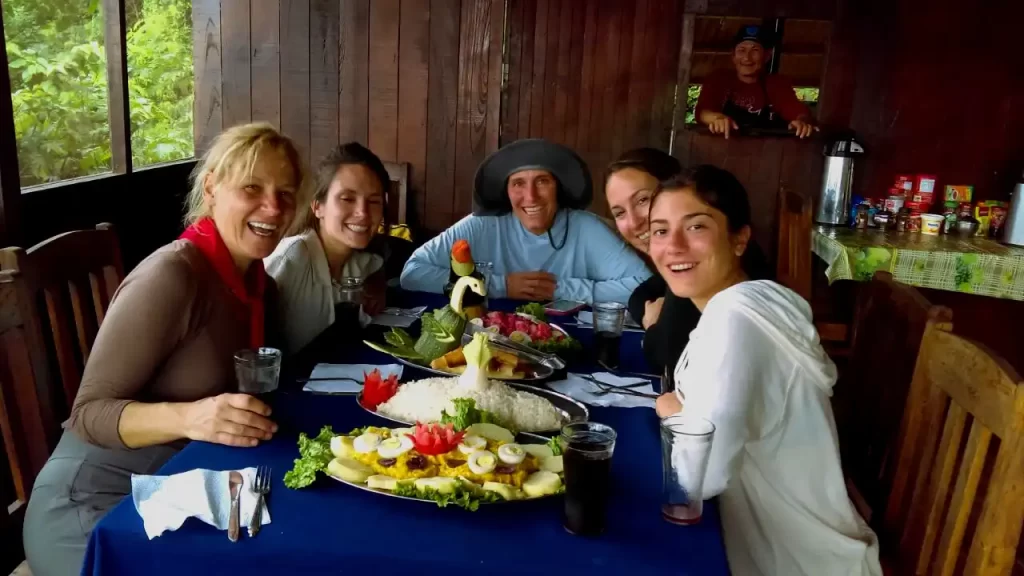
Cultural Zone. The transition zone, on the edge of the protected area, where Andean and Amazonian communities live and where community ecotourism projects are based. Access is more flexible, the Reserved Zone permit is not required, and distances from Cusco are shorter. It is usually chosen when days or budget are limited, or when the interest is as cultural as it is natural. Biodiversity is still remarkable, with cloud forest, smaller clay licks and montane forest birds, though the odds of seeing large mammals are lower. It is also the most sensible format for a first look at the Amazon, such as our 4-day Manu Cultural Zone trip.

How to Get to Manu
Overland from Cusco. This is the usual route and an experience in itself. The road climbs to the Andean passes, crosses Paucartambo, reaches the cloud forest at Acjanaco and then descends for hours toward the lowlands, with the vegetation changing visibly through the window. It is a full day of travel. The route, the stops and what to expect from each stretch are in our Cusco to Manu road trip guide.
Worth knowing: that road crosses the Acjanaco pass at about 3,560 m (11,680 ft) before descending. If you arrive in Cusco and leave for Manu the next morning, you may feel the altitude on exactly the day you are traveling. A few days acclimatizing first prevents it, and our guide to altitude sickness in Cusco explains how.
By small plane. There is an option to fly from Cusco to Boca Manu and skip the road day, normally on charter flights in small aircraft
The river leg. However you arrive, the final stretch inland is always by boat, on the Alto Madre de Dios and the Manu River. It takes several hours, and the wildlife viewing effectively starts there: capybaras, caiman and river birds on the beaches.
Wildlife: What You Can Actually See
The figures usually quoted are over 1,000 bird species and more than 200 mammal species. What matters to a visitor is not the number but that the range of ecological tiers multiplies what you might encounter in a few days.
Birds. The headline group. Macaws and parrots at clay licks, cock-of-the-rock in the cloud forest, hoatzins on the oxbow lakes, toucans, antbirds and a long list beyond. If this is specifically why you are coming, start with our Manu birdwatching guide.
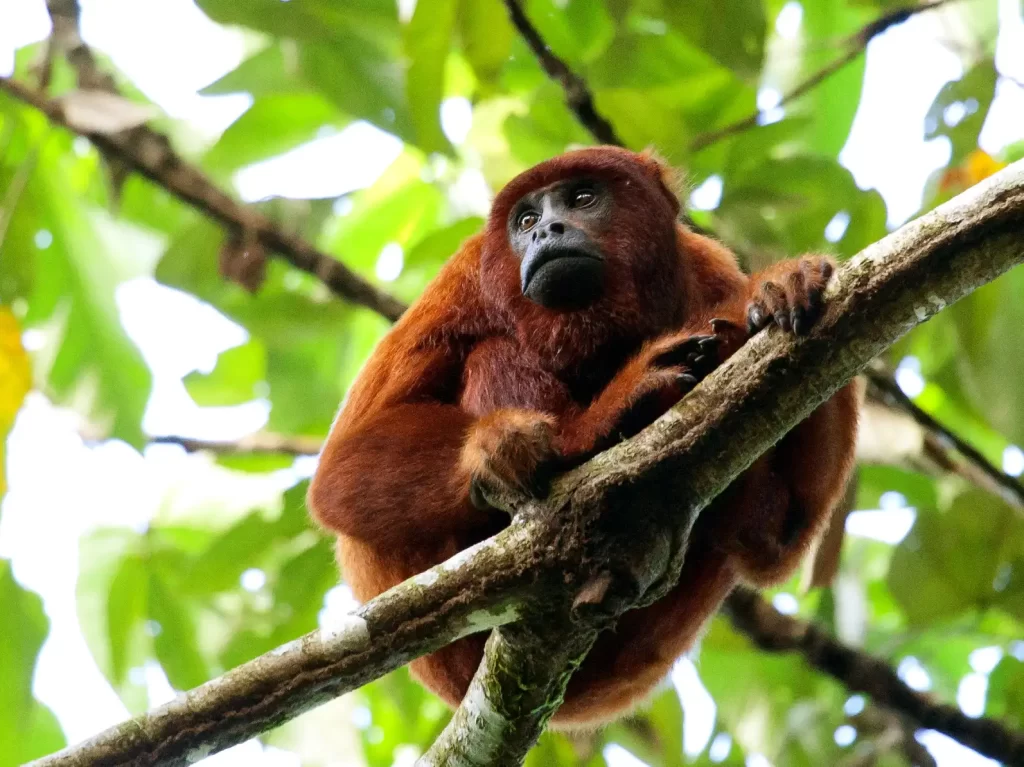
Primates. Several species share the same territory: spider monkeys, howlers, capuchins, tamarins and the tiny pygmy marmoset. They tend to be the most rewarding sightings because they are noisy and active by day. Species detail and where to look for each is in our guide to which monkeys you can spot in Manu.
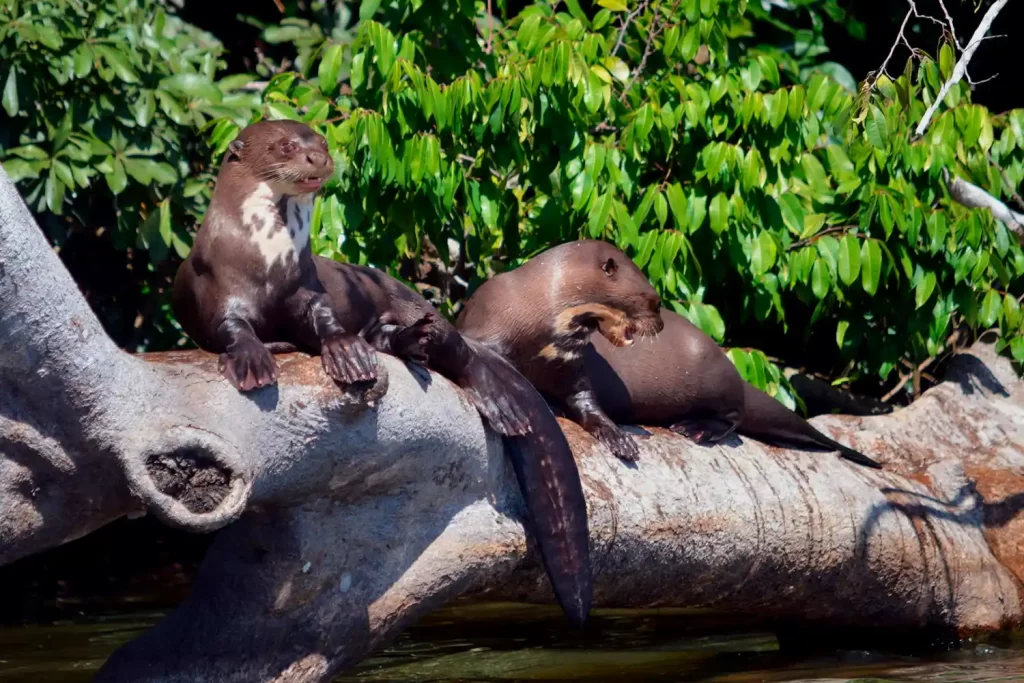
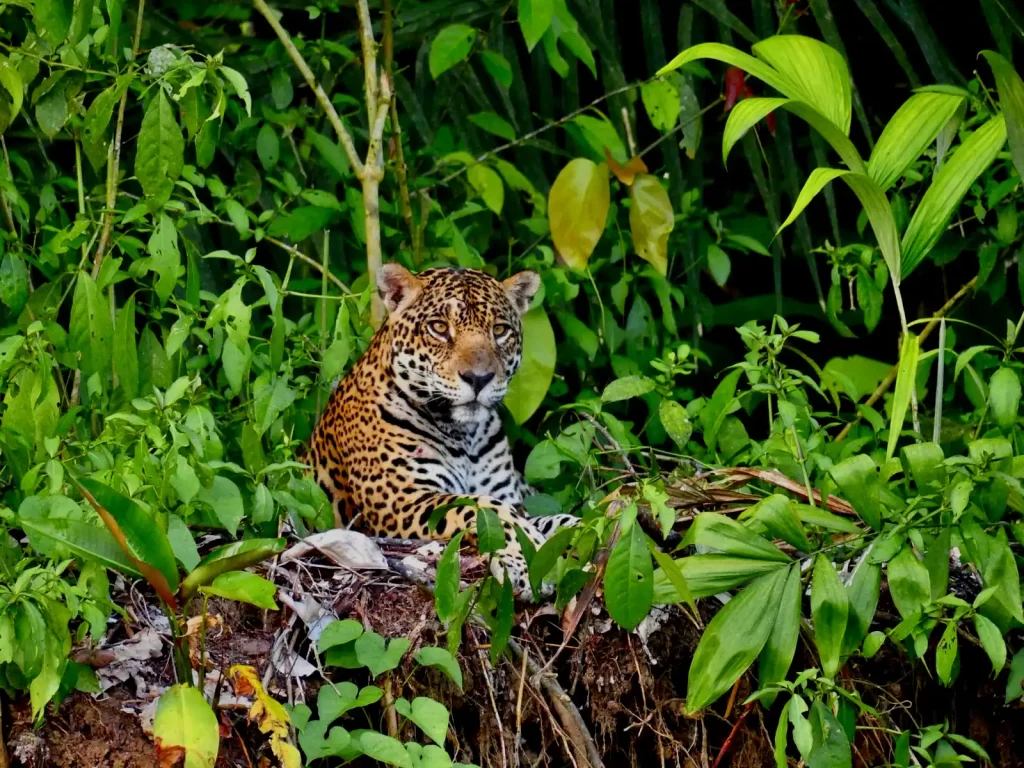
Large mammals. Giant river otters on the oxbow lakes, tapir, peccary, capybara and, with luck and patience, jaguar. No trip guarantees a jaguar sighting, and the odds depend on season, river and hours in the boat: we set out the realistic version in our article on how to see a jaguar in Manu. For an overview of the full species range, see our guide to the animals of Manu and the Peruvian Amazon.
Invertebrates. The overlooked group, and often the highlight of the night walk: butterflies in the hundreds on river beaches, tarantulas, beetles, bullet ants. They are covered in insects of the Peruvian Amazon: tarantulas and butterflies.
Almost all of the lowland wildlife above concentrates in one part of the park. Where and why is explained in our Reserved Zone guide.
The Oxbow Lakes: Cocha Salvador and Otorongo
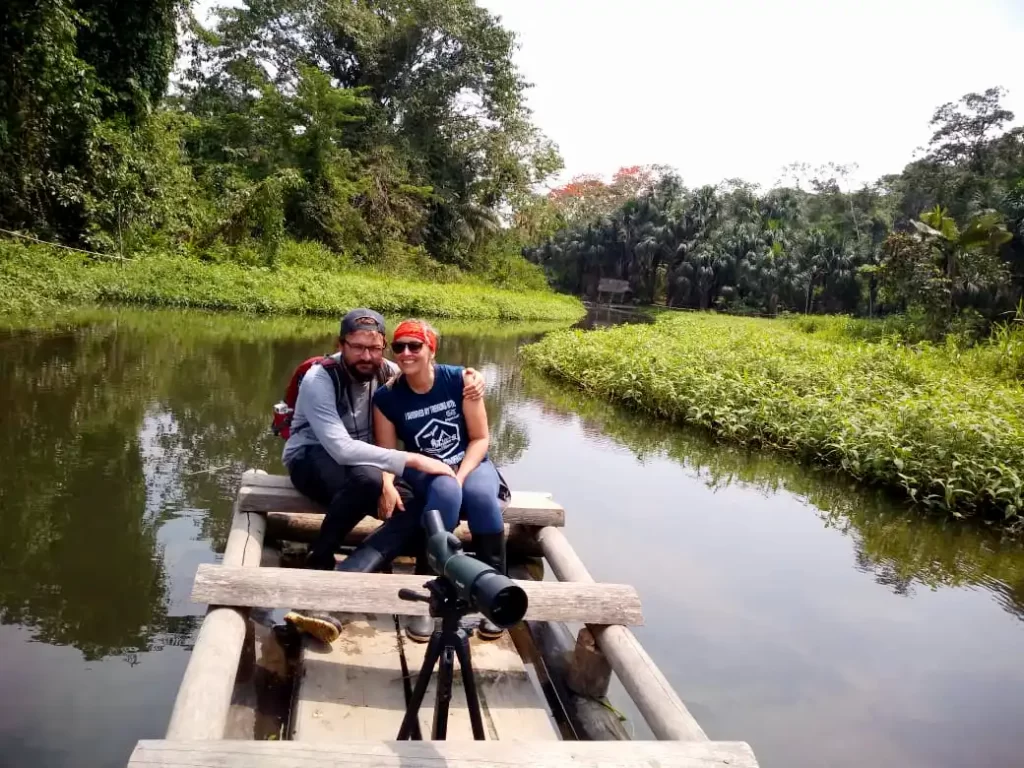
Oxbow lakes, known locally as cochas, are former river meanders left behind when the channel shifted course. They are still, enclosed and rich in fish, which is why they concentrate wildlife like nowhere else in the park. Cocha Salvador and Cocha Otorongo, the two best known, are both inside the Reserved Zone and are explored by paddled catamaran at dawn or dusk, when the giant otter family comes out to fish. Otorongo is usually viewed from an observation tower. What you see at each, at what time of day, and how the visits work is covered in our guide to the oxbow lakes of Manu, Cocha Salvador and Cocha Otorongo.
Best Time to Visit, and the Friaje
Dry season, roughly May to September, is the better window: less rain, lower rivers (which exposes beaches and improves wildlife viewing), walkable trails and more clay lick activity. July and August are the busiest months. Wet season, November to April, does not close the park, but it changes the trip: high rivers, more mud, more mosquitoes and less predictable travel times. In exchange there are fewer visitors, dense vegetation and a great deal of amphibian and insect activity.
Then there is a phenomenon almost nobody mentions and that catches travelers out: the friaje. These are surges of cold southern air arriving from Patagonia that drop rainforest temperatures sharply in a matter of hours, sometimes to 8 to 12 °C (46 to 54 °F), bringing gray skies and drizzle for two to four days. They occur mostly between May and August, in the middle of the dry season. During a friaje animal activity falls sharply, and anyone who packed only for heat has a miserable time. Carrying one warm layer even in June is not excessive caution. Typical daytime temperatures otherwise run around 30 °C (86 °F) with high humidity.
Things to Do Inside the Park
The night walk is, for many visitors, the thing they remember most: the forest changes occupants after dark, and frogs, spiders, snakes and insects appear that simply are not there by day. How it works and what to expect is in our Manu night walk guide.
Clay licks, or collpas, are mineralized clay banks where macaws, parrots and sometimes mammals come to ingest salts. Visits happen at dawn from a blind, and the spectacle depends on weather: on rainy or friaje mornings the birds do not come down.
Also in the repertoire: camping inside the protected area, which means sleeping under a sky with no light pollution, described in our guide to camping in Manu under Amazon stars, and the hot springs of the region, a good closing stop on the way out, covered in our guide to the thermal pools of the Manu jungle. Families should also look at the best activities for children in Manu.
Sustainable Tourism and Local Communities
Manu survives because access is restricted, and that restriction only holds if tourism contributes more than it consumes. In practice that means small groups, local guides, respected observation distances, waste management and lodges that do not run on permanent generators.
It also means recognizing that Manu is not empty territory. Matsigenka, Harakbut and Yine communities live inside and around it, alongside Andean settler populations, as well as peoples in voluntary isolation whose right not to be contacted admits no tourist exceptions. How to choose an operator that genuinely meets these standards, and what to ask before booking, is covered in our article on sustainable tourism in Manu National Park. Our own field practices are set out on our environmental practices page.
Practical Tips: Permits, Health and Packing
Permits. Entering the Reserved Zone requires authorization arranged by an authorized operator, with quotas and deadlines. It cannot be arranged individually on arrival. The full procedure, with documents and deadlines, is in our Manu Reserved Zone permit guide, and the licenses and authorizations an operator must hold are published on our site.
Health. Two different things that are frequently confused:
- Yellow fever: a vaccine exists and is recommended for travel to the Peruvian Amazon. Some neighboring countries also require proof of it if you travel on from Peru. It needs to be given well before departure.
- Malaria: there is no malaria vaccine for travelers. Prevention is by prophylaxis, meaning prescription medication from a doctor, alongside repellent, long sleeves and a mosquito net.
Consult a travel medicine clinic or your own doctor before your trip. They decide what applies to you based on your itinerary, your health and your history. Do not follow protocols from forums or from tour operator websites, including this one.
Packing. The basics: lightweight long-sleeved quick-dry clothing, rain gear, closed shoes with grip, headlamp, repellent, sun protection, binoculars, dry bags for camera equipment and one warm layer in case a friaje arrives. The complete list, with weights and what to leave in Cusco, is in our jungle packing checklist.
Is Manu Safe to Visit?
Yes, with the normal conditions of a remote rainforest destination: travel with an authorized guide, stay with the group, respect distances from wildlife, and accept that medical help is hours away. The real risks are not the ones people fear, meaning animal attacks, but the mundane ones: dehydration, infected cuts, falls on wet trails and insect bites. An honest breakdown of risks, insurance and protocols is in our article on whether Manu National Park is safe.
Manu Compared to Other Amazon Destinations
Against Tambopata, Manu wins on intactness and on ecological gradient: more undisturbed area, less tourist pressure and the chance to cross several tiers in one trip. Tambopata wins on accessibility, a flight to Puerto Maldonado and little else, and on price, while still offering excellent clay licks and wildlife. The detailed comparison is in Manu vs Tambopata.
Against Iquitos, the difference is the type of forest. Iquitos is flooded lowland Amazon, where the river is the absolute protagonist and the logistics are almost entirely fluvial and considerably more comfortable. Manu is Andean foothill rainforest, more varied and harder to reach. We cover it in Manu vs Iquitos, and if you are still deciding what kind of Amazon trip suits you, start with the best way to visit the Peruvian Amazon.
Frequently Asked Questions
Is Manu National Park the same as the Manu Biosphere Reserve? No. The biosphere reserve is a wider UNESCO designation that contains the national park plus buffer areas and communities. Figures quoted for “Manu” often refer to one or the other.
Can I visit Manu National Park independently? Not the Reserved Zone: it requires a permit and an authorized operator. There is more latitude in the Cultural Zone, but distances and river transport make independent travel impractical.
How many days do I need? It depends on the zone and on whether you travel by road or by air. The usual durations and what each buys you are compared in our Manu tour 4 vs 7 days article.
Will I see a jaguar? Probably not. It is a fortunate sighting, not a program inclusion. Anyone guaranteeing one is selling something they do not control.
Is there cell signal or internet? Essentially none inside the protected area. Tell people at home before you go in and expect several days offline.
Is it hot all the time? No. Humid heat dominates, around 30 °C (86 °F), but a friaje can drop temperatures sharply for two to four days, even in the dry season.
What is the difference between the Reserved Zone and the Cultural Zone? The Reserved Zone is inside the park, requires a permit and concentrates the larger wildlife. The Cultural Zone is in the transition area, is easier to reach and combines nature with communities. The full comparison, including price and minimum days, is in our Reserved Zone guide.
Do I need to be physically fit? No special preparation is needed. The demanding parts are heat, humidity and hours in a boat, not elevation gain.
Is Manu suitable for children? It can be, with the right zone and duration. What works well with children is covered in the best activities for children in Manu.
Planning Your Visit
Manu is not a destination you pass through. It is one of the few places where you can still travel a full gradient from Andes to Amazon inside a protected area, and where wildlife behaves as though nobody is watching. What it asks in return is time, permits and a willingness to travel slowly.
If this sounds like your kind of trip, the logical next step is understanding how the zone that concentrates the full experience actually works. Continue with our complete guide to the Manu Reserved Zone, which covers the three zones side by side, permits, how many days you need and what a trip really involves. We are a 100% Peruvian company with an office in Cusco, and you can get in touch with questions at any point.