The Inca Trail 4 days to Machu Picchu is the most iconic trek in South America — a 42 km journey through cloud forests, high Andean passes and ancient Inca ruins that ends with an unforgettable sunrise entrance to the Lost City through the Sun Gate.
Operated by Local Trekkers Peru, a 100% Peruvian and officially licensed tour operator, this classic Inca Trail trek includes all permits, certified bilingual guides, professional cooks, quality camping equipment and buffet-style meals every day on the trail. Permits are strictly limited — only 500 people per day are allowed on the trail. Secure your spot early.
 Locations Visited:
Inca Trail, Machu Picchu & Waynapicchu
Locations Visited:
Inca Trail, Machu Picchu & Waynapicchu
 Starting Altitude:
2720 masl = 8923 pieds
Starting Altitude:
2720 masl = 8923 pieds
 Highest Point:
4200 masl = 13780 pieds
Highest Point:
4200 masl = 13780 pieds
 Group:
Minimum 2 paxs & Maximum 10 paxs
Group:
Minimum 2 paxs & Maximum 10 paxs
 Physical Grading:
4/5
Physical Grading:
4/5
- We have competitive prices
- Fast customer service all the time
- Guaranteed lifetime experience
- We have social responsibility, we do social work


Itinerary
Day-by-Day Inca Trail 4 Days Itinerary
Day 01: Cusco – Km 82 (Piscacucho) – Patallacta – Wayllabamba
Your Inca Trail 4 days adventure begins before dawn. We pick you up from your hotel in Cusco at around 5:00 am and transfer you by private vehicle along the Sacred Valley, with an optional breakfast stop in Ollantaytambo — the last town before the trail.
By the time you reach Piscacucho (Km 82) at 2,720 m, your permits are checked, your team of porters and guides is assembled, and you cross the suspension bridge over the Urubamba River to officially step onto one of the world’s most legendary hiking routes.
Within the first two hours of trekking you reach Patallacta (also known as Llactapata), one of the most significant — and underappreciated — archaeological sites on the entire trail. Rediscovered by Hiram Bingham in 1912 on the same expedition that brought Machu Picchu to the world, this sprawling “high town” served as an agricultural powerhouse, religious center, and military control point for the Inca Empire.
Its four distinct sectors, each anchored by a ceremonial plaza, and its elaborate terrace system — capable of sustaining up to 5,000 people according to modern archaeological estimates — reveal how strategically the Incas engineered their sacred road to Machu Picchu. Your certified guide will bring this history to life as you take it all in from the trail above.
After a well-earned lunch with views of the Cusichaca Valley, the afternoon leads you through two small Andean communities, where you may pick up last-minute snacks or just absorb the quiet rhythm of highland life. By late afternoon you arrive at Wayllabamba (3,000 masl) — your first campsite, where hot tea, snacks, and a full buffet dinner await you. Settle into your four-season tent and let the silence of the Andes prepare you for what comes tomorrow.
CONSIDERATIONS:
- Meals: Lunch, snacks, afternoon tea time, and dinner.
- Accommodation: Camping facilities.
- Distance: 12 km / 7.5 miles.
- Difficulty: Easy/Moderate.
- Walking Time: Approximately 5 – 6 hours.
Day 02: Wayllabamba – Dead Woman’s Pass (4,215 m) – Pacaymayo Valley
The classic Inca Trail trek is the one everyone talks about. You’re woken before sunrise with a steaming cup of coca tea — a ritual as old as the Inca themselves, used for centuries to combat altitude fatigue and honor the Apus, the sacred mountain spirits of the Andes. Breakfast is hearty, because you’ll need every calorie for what lies ahead.
The morning is a sustained climb through a dramatic transition of ecosystems: from the Polylepis cloud forest — home to tanagers, hummingbirds, and the rare Andean spectacled bear — into the high puna grasslands above the tree line, where the air grows thin and the sky enormous.
This ascent leads to Warmiwañusca, better known as Dead Woman’s Pass, the highest point of the entire Inca Trail 4 days route at 4,215 m (13,829 ft) above sea level. The name comes from the silhouette the mountain ridge forms — resembling a woman lying on her back — though for every hiker who reaches the summit, it feels more like a rebirth.
The panoramic views of the Vilcabamba and Salkantay ranges from this point are unlike anything you’ll see at ground level. After a well-deserved rest and photographs at the top, the descent takes you down into the protected Pacaymayo Valley (3,600 m / 11,811 ft), a lush river basin flanked by waterfalls and dramatic Andean peaks.
The campsite here, set beside the Pacaymayo River, is one of the most atmospheric of the entire trek. On a clear night, the Southern Hemisphere sky above camp reveals Andean constellations that Inca astronomers mapped long before European contact. Dinner is served, and the stars do the rest.
CONSIDERATIONS:
- Meals: Lunch, snacks, afternoon tea time, and dinner.
- Accommodation: Camping facilities
- Distance: 13 km / 08 miles.
- Difficulty: Moderate/Challenge.
- Walking Time: Approximately 07 – 09 hours.
Day 03: Pacaymayo – Runkurakay – Sayacmarca – Phuyupatamarca – Wiñaywayna
Most hikers say it’s where the 4 day Inca Trail truly reveals its soul. The physical challenge is still real, but the archaeological density and landscape variety of this stage make it feel like walking through a living history museum suspended in the clouds.
The morning ascent leads first to Runkurakay (3,800 m) — a semi-circular Inca ruin believed to have served as a tambo, or official rest house, for the Inca messenger runners (chasquis) who relayed information across the empire at speeds that astonished Spanish conquistadors.
Its unusual round shape makes it one of the most visually distinctive ruins on the entire trail. From Runkurakay Pass, the second-highest point of the trek, you get sweeping views of snow-capped Salkantay (6,271 m) — the most sacred Apu of the Cusco region — rising above the Vilcabamba range.
Descending through moss-covered tunnels of cloud forest, you reach Sayacmarca — the “Inaccessible Town” — a fortress-like complex perched on a narrow ridge with natural defensive advantages on three sides.
Its water channels, terraces, and ceremonial spaces point to a site that functioned as both a military outpost and a ritual center. Then comes the “Inca Flat,” a rare level stretch of ancient stone pavement offering unobstructed views all the way to the Salkantay and Vilcabamba glaciers — a photographer’s dream and a hiker’s relief.
The afternoon brings you to Phuyupatamarca — “Town Above the Clouds” — at 3,650 m, where five perfectly preserved Inca fountains still flow with mountain water after five centuries.
Below, the cloud forest opens into a world of orchids, bromeliads, parrots, and parakeets as you descend a dramatic Inca staircase to your final campsite at Wiñaywayna (“Forever Young”), 2,700 m — the most spectacular campsite of the trek, built into steep terraces above the Urubamba gorge, just two hours from Machu Picchu.
Tonight, your porters and guides celebrate the end of their trail with you — a tradition worth honoring.
CONSIDERATIONS:
- Meals: Breakfast, Lunch, snacks, afternoon tea time, and dinner.
- Accommodation: Camping facilities.
- Distance: 15km / 9.3 miles.
- Difficulty: Moderate/Challenge.
- Walking Time: Approximately 08 – 10 hours.
Day 04: Wiñaywayna – Sun Gate (Inti Punku) – Machu Picchu – Cusco
The alarm goes off before 4:00 am, but no one minds. After a packed breakfast, you join the line at the Wiñaywayna checkpoint — which opens at 5:30 am — for the final push of your Inca Trail 4 days journey. The trail through the high jungle is narrow, draped in orchids and mist, and deceptively steep near the end — a final set of Inca stairs nicknamed the “Gringo Killer” before the stone archway of Inti Punku, the Sun Gate, emerges above you.
When you step through that gate and Machu Picchu appears below — wreathed in morning clouds, flanked by the peak of Huayna Picchu, exactly as it was when Inca priests and nobility walked this same path — the emotion is something no photograph prepares you for.
This entrance through the Sun Gate is exclusive to Inca Trail hikers: no bus, no train, no shortcut leads here. You earned this view with every step of the last three days.
After soaking in the panorama, you descend the final stretch to Machu Picchu and begin your 2–3 hour guided tour of the citadel with your certified bilingual guide — covering the Temple of the Sun, the Intihuatana (“hitching post of the sun”), the Room of the Three Windows, and the agricultural terraces that still define the skyline.
When the tour concludes, you take the bus down to Aguas Calientes for a free lunch and rest before boarding your tourist train back to Ollantaytambo, where our private transport returns you to your hotel in Cusco. The trek is over. The memory is permanent.
CONSIDERATIONS:
- Meals: Breakfast.
- Distance: 5km / 3.1 miles.
- Difficulty: Easy.
- Walking Time: Approximately 2 – 3 hours.
Map
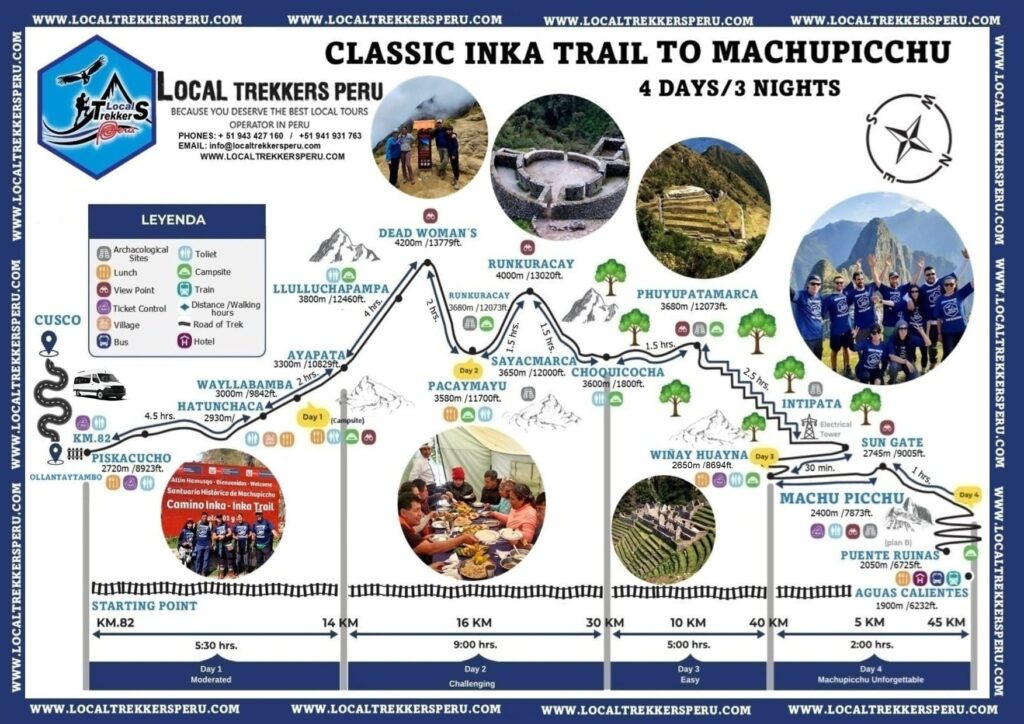
Inca Trail 4 Days — Complete Route Map with Elevation Profile and Campsites
This map shows the complete route of your Inca Trail 4 days trek — from the starting point at Km 82 (Piscacucho, 2,720 m) through all four stages, three campsites, and six archaeological sites, ending at the Sun Gate and Machu Picchu (2,430 m).
Each section of the trail crosses a distinct ecological zone and elevation band.
Day 1 follows the Urubamba and Cusichaca river valleys at moderate altitude, passing Patallacta before climbing to Wayllabamba (3,000 m).
Day 2 is the most demanding ascent of the route, rising sharply to Dead Woman’s Pass at 4,215 m — the highest point of the entire trek — before descending into the Pacaymayo Valley (3,600 m).
Day 3 traverses three Inca archaeological sites at mid-altitude, dropping from Phuyupatamarca (3,650 m) through cloud forest to the final campsite at Wiñaywayna (2,700 m).
Day 4 is a short, gentle hike through high jungle to the Sun Gate (2,730 m) and down into Machu Picchu.The total trekking distance is 42 km (26 miles) across four days, with a maximum elevation gain of +1,495 m on Day 2. All campsites are officially designated by the Peruvian Ministry of Culture and assigned at the time of permit booking.
Inclusions
Includes:
- Bilingual and certified Tour Guide
- A briefing about the machu picchu hike with your guide the day before
- Porters to carry all camping equipment and kitchen stuff
- Permits for the Inca Trail hike, including entrance to Machu Picchu and porters’ permits
- Pick-up from your accommodation in Cusco, Urubamba, or Ollantaytambo
- Private transportation to the Trailhead
- A Survivor T-shirt for each member of the group
- Touristic train from Aguas Calientes to Ollantaytambo (for the return from your Machu Picchu hike tour)
- A Duffle bag for your personal belongings (7kg limit, including your sleeping bag), carried by porters
- Private Transportation from Ollantaytambo to Cusco
- Four-season Tents (Doite Andina XR4 ) – 2 trekkers per tent with plenty of space
- Camping equipment (kitchen tent, portable chairs, and tables)
- Bus ride from Machu Picchu to Aguas Calientes on the 4th day
- Comfortable Foam Mattresses for each trekker
- Small Pillow for each Trekker
- 3 Meals per day during the trek (buffet style)
- Professional Cook
- Snacks for each day of trekking
- Boiled water to drink during the trail
- Availability of meals to your preference (vegetarian, vegan, gluten-free, pescetarian, etc.)
- First Aid Kit with Oxygen balloon.
Doesn’t includes:
- Mineral water (you can buy bottled water in Ollantaytambo and at the first campsite)
- First breakfast and last lunch and dinner
- Upgrade your Touristic Train to a Luxury Vistadome Train to Ollantaytambo ($50 USD )
- Entrance ticket to Huayna Picchu mountain ($65 per person)
- Tips for the team (not obligatory but welcome)
- Air Mattress – $20 USD per person (Therm-a-rest mattresses)
- Sleeping bag rental: $20 USD for a professional goose feather bag that can withstand up to -15 degrees Celsius
- Hiking pole rental: $20 USD for a professional pair.
packing list
What to Pack for the Inca Trail 4 Days Trek at High Altitude
- Original Passport
- A valid student card if you book this trek as student (25 years old as máximum)
- Travel Insurance card (you have to le tus know the name of your Travel Insurance company and you travel Insurance Number)
- Day Pack.
- Rain coat or Rain Poncho
- Cold Clothes (For the first and Second day)
- Trekking shirts and trekking pants
- Waterproof hiking shoes
- Bottle of Water
- Flash Light
- Toilet Paper
- Sun Block
- Sun Glasses
- Caps or Hats
- Gloves (for the first and second day)
- Insect Repellent (30% DEET Recommended)
- Sleeping Bags
- Walking sticks
- Camera with extra batteries
- Extra money especially in soles to buy thing along the trek
POSITIVE MENTAL ATTITUDE.
Price
Price of the Inca Trail 4 days 2026–2027
The cost of the Inca Trail 4 days covers everything you need from Cusco to Machu Picchu and back. All government-issued permits, professional bilingual guides, full camping equipment, buffet-style meals on the trail, porters, and your return train and bus are included in the price. No hidden fees, no surprises on the trail — just the adventure.
Permits for the Inca Trail are strictly limited to 500 people per day by the Peruvian Ministry of Culture and sell out months in advance, especially for the dry season (May–September). We recommend booking at least 3–4 months ahead to secure your preferred dates.
SHARED SERVICE – PRICE PER PERSON:
- From 795 USD for Adults
- From 765 USD for Children and Students (up to 17 years old)
PRIVATE SERVICE – PRICE PER PERSON:
- From 1450 USD for Adults
- From 1420 USD for Children and Students (up to 17 years old)
To book the Classic Inca Trail to Machu Picchu, you will need to make an initial payment of 300 USD per person or 370 USD If You want to add the visit to the Huaynapicchu Mountain. The rest of the total Price you can complete it 10 days before the Trek starts, or 2 Days before the Trek starts directly at our Office once you are in Cusco.
STUDENT DISCOUNT:
- All travelers under 17 will have a $30 discount.
If you are 25 years old or under when traveling, you can get a 30$ discount with your Student ID Please advise by email to give you the discount.
VALID STUDENT ID FOR INCA TRAIL AND MACHU PICCHU
To get the student discount, travelers should have a Valid ID with the following:
- 25 years or less at the time of entering Machu Picchu. Older than 25 can not enter as a student
- The ID must have the Name of the university, name, and photo of the student
- The ID must have a valid expiration date
Travel Info
Everything You Need to Know Before Hiking the Inca Trail 4 Days
¿How Difficult Is the Inca Trail 4 Days?
The Inca Trail 4 days is rated moderate to challenging — suitable for people with a reasonable level of fitness who have done some hiking before. You do not need to be an athlete, but preparation matters.
The hardest section is Day 2, where you ascend to Dead Woman’s Pass at 4,215 m (13,829 ft) over approximately 4 hours of continuous uphill. The main challenges are:
- Altitude — the trail spends most of its duration above 3,000 m, where oxygen levels are noticeably lower
- Sustained elevation gain — Day 2 climbs over 1,200 m in a single stage
- Uneven terrain — original Inca stone steps, narrow ridgelines, and root-covered forest paths
- Duration — Days 2 and 3 involve 7–10 hours of active trekking
Recommended preparation: Start cardio training (hiking, running, cycling) at least 6–8 weeks before your trek. Spend a minimum of 2 nights acclimatizing in Cusco (3,400 m) before Day 1.
¿When Is the Best Time to Hike the Inca Trail?
The Inca Trail is open from February to January, with a mandatory closure every February for trail maintenance.
Dry season (May to September) is the most popular and recommended time to hike. Skies are clear, views from Dead Woman’s Pass and Phuyupatamarca are at their best, and trail conditions are at their safest. June, July, and August are peak months — permits sell out the fastest during this period, sometimes 4–5 months in advance.
Shoulder season (April and October) offers a good balance: fewer crowds, green landscapes from recent rains, and permits that are slightly easier to secure.
Rainy season (November to March) brings daily afternoon rain, muddy trails, and reduced visibility. The trail remains open, and some hikers prefer the lush scenery and smaller groups, but the experience is more physically demanding.
| Season | Months | Conditions | Permit Availability |
| Dry | May – Sept | Best visibility, dry trails | Books out fast |
| Shoulder | Apr / Oct | Some rain, lush & green | Moderate |
| Rainy | Nov – Mar | Rain, mist, mud | More available |
| Closed | February | Trail maintenance | No permits issued |
How to Get Inca Trail Permits for 2026
Inca Trail permits are issued by the Peruvian Ministry of Culture and are strictly limited. Only 500 people per day are allowed on the trail — including guides and porters — which means the actual number of trekking spots per day is closer to 200.
Key facts about permits:
- Permits are non-transferable — your full name and passport number are printed on the permit and checked at every checkpoint
- You cannot purchase permits independently — they must be booked through a licensed tour operator like Local Trekkers Peru
- For 2026 dry season dates, permits are already limited — we recommend booking now to avoid losing your preferred dates
- A deposit is required at the time of booking to secure both your permit and campsite
When you book with Local Trekkers Peru, we handle the entire permit process for you the moment your deposit is confirmed.
¿What Is the Best Way to Acclimatize Before the Inca Trail?
Altitude sickness (soroche) is the most common reason hikers struggle on the trail. Cusco sits at 3,400 m — already high enough to cause headaches, fatigue, and nausea in people who arrive from sea level without allowing time to adjust.
Recommended acclimatization plan:
- Arrive in Cusco at least 2 nights before your trek departure — ideally 3
- Avoid alcohol and heavy meals for the first 48 hours in Cusco
- Drink coca tea — widely available in Cusco and genuinely effective at easing altitude symptoms
- Stay hydrated — aim for 3–4 liters of water per day starting 2 days before the trek
- Take it slow — avoid strenuous activity on your first day in Cusco
- Consult your doctor about acetazolamide (Diamox) if you are particularly sensitive to altitude
Day trips to the Sacred Valley (which sits at a lower elevation than Cusco) before your trek are also a great way to ease your body into the altitude gradually while sightseeing.
¿How Small Are the Groups on the Inca Trail?
Local Trekkers Peru operates in small groups of maximum 16 trekkers, which is significantly smaller than the legal maximum of 200 per day. Small groups mean a more personal experience with your guide, faster movement through checkpoints, better campsite positions, and a more intimate connection with the trail and its history.
Private treks for couples, families, or corporate groups are also available on request.
¿Can I Hike the Inca Trail on My Own?
Independent trekking on the Classic Inca Trail is not permitted. Since 2002, the Peruvian Ministry of Culture has required that every hiker complete the route through a licensed and officially registered tour operator. This regulation exists to protect both the archaeological sites and the fragile ecosystems along the trail, as well as to guarantee the safety of all trekkers.
This means you cannot purchase an Inca Trail permit directly as an individual — the permit must be processed by an authorized operator like Local Trekkers Peru, who also provides your certified guide, porter team, and all required logistics. Every checkpoint along the 42 km route verifies that each hiker is accompanied by their registered operator’s team.
The good news: having a knowledgeable local guide transforms the experience entirely. Rather than walking past ruins, you understand them.
¿Is the Inca Trail Suitable for Children and Older Travelers?
There is no official age restriction set by the Peruvian government for the Inca Trail 4 days. However, the physical demands of the route — particularly the 1,200 m elevation gain to Dead Woman’s Pass on Day 2 — mean that fitness and prior experience at altitude matter far more than age alone.
General guidelines:
- Children: Most operators recommend a minimum age of 10–12 years old. Active, fit children who are comfortable hiking 5–8 hours per day and have acclimatized properly in Cusco can complete the trail successfully. Parental consent documentation is required for minors traveling with one parent or a third party
- Older travelers: There is no upper age limit. Active travelers in their 60s and 70s regularly complete the Inca Trail 4 days with no issues, provided they have a good fitness base, allow adequate acclimatization time, and consult their doctor beforehand regarding altitude
- Medical conditions: The trail is not recommended for travelers with cardiovascular problems, severe respiratory conditions, or pregnancy
If you have any doubts about suitability, contact us before booking and we will give you an honest assessment.
¿How Much Should I Tip My Guide and Porters?
Tipping on the Inca Trail is not mandatory but is a deeply meaningful gesture — and one that is genuinely expected by the local teams who make the experience possible. Guides and porters are predominantly from Quechua-speaking Andean communities, and tips represent a significant portion of their income.
Suggested tipping guidelines per trekker:
| Role | Suggested Tip |
| Lead guide | $30–50 USD |
| Assistant guide | $20–30 USD |
| Personal porter (7 kg) | $20–30 USD |
| Cook | $20–25 USD |
| Camp porter (equipment) | $15–20 USD |
Tips are best given in cash (Peruvian soles or USD) in separate envelopes, handed directly to each team member on the evening of Day 3 at Wiñaywayna — a tradition that has become one of the most memorable moments of the trek. Your guide will let you know the right moment.
Peruvian law caps the maximum load a porter can carry at 25 kg total, of which around 5 kg is their own personal gear.
¿What Happens If I Need to Cancel or Change My Booking?
Inca Trail permits are issued by the Peruvian Ministry of Culture and are strictly non-transferable and non-refundable once purchased. This is not an operator policy — it is a government regulation that applies to every licensed company without exception.
Key things to understand before booking:
- The name and passport number printed on your permit must match exactly what is presented at every trail checkpoint. If you renew your passport after booking, bring both the old and new passport on the trek
- No name changes or date changes are possible once a permit is issued — any modification results in the automatic cancellation of the permit with no refund
- If you need to cancel your trek, the permit cost is non-recoverable. The remaining portion of the tour cost (transport, accommodation, meals) is subject to Local Trekkers Peru’s cancellation policy, which we provide in full at the time of booking
- Travel insurance that covers trek cancellation, altitude-related illness, and emergency evacuation is strongly recommended — and required for all our departures
For this reason, we recommend booking as early as possible for your preferred dates, especially for dry season departures between May and September.
¿What Happens to My Trek If There Is a Strike or Protest in Peru?
Strikes and social protests are a reality of travel in Peru and occur most commonly between December and March, though they can happen at any time of year. They typically involve road blockades or railway stoppages that can temporarily interrupt access between Cusco, the Sacred Valley, Aguas Calientes, and the Inca Trail trailhead at Km 82.
Strikes in Peru are frequent and can disrupt tours — roads are often blocked and trains stopped. It’s important to understand how this affects your trek and what Local Trekkers Peru does to protect your experience:
What can be affected:
- Road access from Cusco to Km 82 on departure day
- Train service between Aguas Calientes and Ollantaytambo on the return (Day 4)
- Access to Machu Picchu if protests reach Aguas Calientes
What Local Trekkers Peru does:
- We monitor road and railway conditions in real time before and during every departure
- If a strike is announced or anticipated, we may advance your departure by one day to get you to the trailhead before roads are blocked — at no extra cost to you
- Once you are on the trail, strikes do not affect the trek itself. The Inca Trail runs through protected territory managed by the Ministry of Culture and is not accessible to protesters
- In the unlikely event that the return journey on Day 4 is disrupted, our operations team coordinates alternative transport options and keeps you informed at every step
- If a strike makes it impossible to complete the tour safely, we will work with you on rescheduling or alternative solutions
What you can do:
- Travel insurance that covers strikes, civil unrest, road closures, and trip disruption is strongly recommended — it is the single best protection against costs outside anyone’s control
- Stay flexible with your post-trek schedule in Cusco — allowing one extra day after your return gives you a buffer against any last-minute disruptions on Day 4
- Register your travel plans with your country’s embassy in Lima before departing for the trail
Strikes are unpredictable by nature, but with the right operator and the right insurance, they very rarely result in a cancelled trek. In over a decade operating the Inca Trail, our team has successfully managed departures through multiple strike periods without a single group missing Machu Picchu.
Travel Info
Frequently Asked Questions about Inca Trail 4 Days
Resolvemos todas tus dudas antes de reservar tu viaje.
The Inca Trail 4 days is the classic 42 km trekking route that connects the Sacred Valley to Machu Picchu following original stone paths built by the Inca civilization. Over four days and three nights of camping, you cross three Andean mountain passes, visit six archaeological sites — including Patallacta, Runkurakay, Sayacmarca, Phuyupatamarca, Wiñaywayna, and the Sun Gate — and arrive at Machu Picchu through the historic Inti Punku entrance. It is consistently ranked as one of the top ten trekking routes in the world and the single most iconic way to reach Machu Picchu.
For dry season dates between May and September, we recommend booking at least 4–6 months in advance. Permits for peak months like June, July, and August can sell out as early as October of the prior year. For shoulder season dates in April or October, 2–3 months is generally sufficient, though earlier is always better.
The government limits access to 500 people per day including guides and porters — which means the actual number of trekker spots available is closer to 200. Once those permits are gone, no waitlist exists. If your preferred date is fully booked, the Short 2-Day Inca Trail or the Salkantay Trek are the best alternatives.
Most nationalities — including citizens of the USA, UK, Canada, Australia, and all EU countries — do not need a visa to enter Peru as tourists. You will receive an entry stamp at the airport valid for up to 183 days. What you do need is your original passport on the day of the trek. Photocopies are not accepted at the trail checkpoints.
The name and number on your permit must match your passport exactly. If you are in the process of renewing your passport at the time of booking, contact us — we will guide you through the correct procedure to avoid any issues at the checkpoint.
No vaccines are required to hike the Inca Trail. Although the trail passes through cloud forest on Days 3 and 4, no cases of yellow fever have been reported in that area, so no yellow fever vaccination is necessary.
Standard travel health precautions apply: consult your doctor before traveling to Peru regarding any personal health conditions, altitude sensitivity, or medication needs. Travel insurance that includes emergency medical evacuation is required for all our departures.
Each trekker is assigned a personal porter who carries a duffel bag of up to 7 kg (15 lb) of your personal gear — this typically includes your sleeping bag, sleeping mat, and 3–4 days of clothing. Your porter will receive the duffel bag at the pre-trek briefing the evening before departure. You will not have access to it during the hiking hours of each day; it will be waiting for you at the campsite each afternoon.
During the day you carry your own daypack with water, snacks, documents, rain gear, sunscreen, and camera. Peruvian law sets the maximum total load a porter can carry at 20 kg for men and 15 kg for women, including their personal belongings and company equipment. At Local Trekkers Peru we strictly enforce this limit as part of our responsible porter welfare commitment.
A sleeping bag is not included in the standard tour price but is available for rent from Local Trekkers Peru. Given that temperatures at camp can drop to 0°C or below during the dry season (May–September), we strongly recommend a 4-season sleeping bag rated to at least -10°C (14°F).
If you prefer to bring your own, make sure it fits within your 7 kg duffel allowance. Sleeping mats are provided by us as part of the camping equipment.
Shower and toilet facilities exist at each campsite but vary considerably by location. The first campsite at Wayllabamba has both cold and hot showers available, with local residents offering hot showers for a small fee of around 10 soles. The second campsite at Pacaymayo has public showers but the water is extremely cold and not recommended.
The third campsite at Wiñaywayna also has cold showers, but the lower altitude makes the water somewhat warmer and more manageable. We provide a private portable toilet tent at every campsite — a significant comfort advantage over operators who rely solely on public facilities. Baby wipes are highly recommended for daily freshening up between camp stops.
Yes — the Peruvian government offers a reduced permit price for students with a valid ISIC card (International Student Identity Card). The physical student card must be presented at the Km 82 checkpoint on the day of departure — a digital copy or any other student ID is not accepted.
If you do not have a valid ISIC card, the standard adult permit price applies. Contact us before booking to confirm the current student permit rate for your travel dates. Come See Peru Tours
The pre-trek briefing takes place at our office in Cusco on the evening before your departure, usually between 6:00 and 8:00 pm. During this meeting your guide will walk you through the full itinerary, explain what to pack in your duffel bag vs. your daypack, distribute duffel bags, and answer any last-minute questions.
Attendance is mandatory. We also use this time to weigh duffel bags and confirm your passport details against your permit. The briefing usually lasts around 45–60 minutes and is a great opportunity to meet your fellow trekkers.
Your safety is always the first priority on the trail. If a trekker becomes unable to continue due to altitude sickness, injury, or any medical condition, our certified guides are trained in high-altitude first aid and carry emergency oxygen on every departure.
Depending on the severity of the situation, options include resting and acclimatizing at camp, adjusting the pace, or organizing an emergency evacuation from the nearest exit point. The trail has designated emergency exits at certain points, and our team maintains contact with support staff throughout the route.
This is one of the most important reasons why travel insurance with emergency medical evacuation coverage is required — evacuation from remote sections of the Inca Trail can be expensive and logistically complex without it.
The 4-day Classic Inca Trail covers the full 42 km route from Km 82, passing through all major archaeological sites and three mountain passes, with three nights of camping. It is the only version that includes the complete experience from the Andean highlands down to the cloud forest.
The 2-day Short Inca Trail starts at Km 104 and covers only the final section of the route — approximately 12 km — with one night in Aguas Calientes or camping at Wiñaywayna. It reaches Machu Picchu via the Sun Gate but skips Dead Woman’s Pass and most of the archaeological sites.
The 4-day is the definitive experience; the 2-day is the best alternative when time or permit availability is limited.
Any bags you are not taking on the trek — suitcases, extra clothing, valuables — can be stored securely at your hotel in Cusco or at our office free of charge during the four days of the trek. You will return to Cusco on Day 4 in the evening, so your stored luggage will be ready and waiting.
We strongly advise against leaving valuables in your duffel bag that goes with the porter team. Keep your passport, cards, cash, and electronics in your daypack with you at all times on the trail.