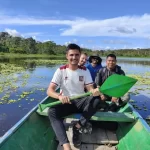
The Manu Reserved Zone is the only part of Manu National Park open to in-depth nature tourism: the only zone where you sleep inside the protected area and reach the oxbow lakes and clay licks where the wildlife concentrates. The park has three zones, they are not interchangeable, and the one on your itinerary decides whether your mornings are spent watching giant otters fish or looking at recovering forest from the park’s edge.
We are Local Trekkers Peru, a 100% Peruvian company with a physical office in Cusco, and we run this route through the season with our own guides and camp teams. This guide covers the zone, how it compares with the other two, what you see, permits, days, getting in, when to go, packing and cost, each at a general level, with a link to the article that goes deep.
What Is the Manu Reserved Zone?
Manu National Park covers 1,716,295 ha (4.24 million acres) of southeastern Peru, across Cusco and Madre de Dios, falling from Andean grassland above 4,000 m (13,120 ft) to lowland rainforest at roughly 300 m (985 ft). The Reserved Zone is one of its three management categories, administered by SERNANP, Peru’s protected areas service, and covers around 257,000 ha (635,000 acres) [VERIFY: exact area of the Reserved Zone in hectares and acres against SERNANP, and confirm it matches the Spanish pillar].
It follows the lower Manu River. Boats enter at Boca Manu, where the Manu meets the Alto Madre de Dios at about 300 m (985 ft), and run upriver past the Limonal control post to the two oxbow lakes that anchor almost every itinerary, Cocha Salvador and Cocha Otorongo. Pakitza marks the upstream limit; above it is Core Zone, and closed.
What defines the zone in practice is the tourism allowed inside it: no roads, no towns, no independent travel. You arrive by river with an authorized operator, on a permit filed in advance, and sleep at a handful of fixed camps. That is why the wildlife is still there in these densities. Our official authorizations and licenses page shows what it takes to bring a group past Limonal.
Manu’s Three Zones, and Why This Decides Your Trip
Most Manu pages skip this, and it is why travelers buy the wrong tour. “Manu tour” covers at least two different trips at two very different prices.
| Core Zone | Reserved Zone | Cultural Zone | |
|---|---|---|---|
| Access | Closed. Researchers only | Authorized operators only, permit filed in advance, river access | Open, road accessible, no permit |
| What you see | Not applicable | Oxbow lakes, clay licks, giant otters, monkeys, intact forest | Cloud forest, cock-of-the-rock lek, hot springs, forest edge wildlife |
| Relative price | Not applicable | Highest | Lowest |
| Minimum days | Not applicable | 5 days | 3 days |
| Who it suits | Nobody. No visitor access | Travelers whose main goal is wildlife | Short budget trips, cloud forest birding |
The Cultural Zone is a good place: cloud forest birding, thermal pools, river life, sensible for three days on a small budget. It is not the deep Amazon. It sits on the park’s edge along the road corridor and never reaches the oxbow lakes or the big clay licks. When someone comes home saying they “didn’t see anything”, their tour almost certainly never entered the Reserved Zone. Our complete guide to Manu National Park covers how the park is organized.
So before booking, ask in writing whether the itinerary enters the Reserved Zone. A real one names Cocha Salvador or Cocha Otorongo and runs at least five days.
What You’ll Actually See in the Reserved Zone
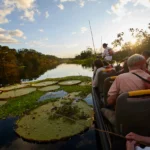
The oxbow lakes are the heart of it. Cocha Salvador and Cocha Otorongo are old river bends cut off from the Manu, still and dark, crossed at first light on a wooden catamaran platform. They hold resident families of giant otters that fish, argue and haul out on logs in full view, plus black caiman, hoatzins and horned screamers. Our guide to the oxbow lakes of Cocha Salvador and Cocha Otorongo covers what the otter families do through the year.
The clay licks are the other set piece. At dawn, parrots and parakeets gather on exposed riverbank clay, and on the larger licks scarlet, red-and-green and blue-and-yellow macaws come down once the light is up. The best known sits at Blanquillo, just outside the zone’s boundary, which is why we run a dedicated 6-day Reserved Zone and Blanquillo macaw clay lick tour.
Birds are why many people come. Manu’s list is one of the longest of any protected area on earth, well over a thousand species across the elevation gradient [VERIFY: bird and mammal species counts against SERNANP, and confirm they match the Spanish pillar]. In the lowlands that means macaws, toucans, trogons, curassows, herons and skimmers; our birdwatching guide to Manu breaks the list down by habitat.
Mammals are less predictable and more rewarding. Monkeys are the near certainty, from squirrel monkeys and capuchins to tamarins, howlers and spider monkeys, and our guide to Manu’s monkeys explains which troops you meet where. Beyond primates there are peccary herds, capybara on the sandbanks, tapir tracks at the licks and, on a lucky bend, a jaguar on the sand. Nobody honest promises a jaguar, but here it is a real possibility, and how to improve your chances explains what raises the odds.
Smaller life fills most people’s photos too: see Amazon insects, tarantulas and butterflies, and the wildlife of Manu for the rest by group.
Permits and How You Get In
You cannot file a Reserved Zone permit yourself. Entry is granted through SERNANP to authorized operators, who submit the group’s details in advance and are responsible for the party inside the zone. We need your full name as it appears on your passport, passport number, nationality, date of birth and travel dates, sent early: permits are tied to named people and fixed dates.
Capacity inside the zone is limited, which is the point [VERIFY: whether a fixed daily visitor quota or permit cap exists for the Reserved Zone, and the exact figure]. For May to September departures, confirm three to six months ahead: camp space and permit slots for the peak weeks go first.
Your permit is checked at the control post, and your guide carries the paperwork. The documents, deadlines and what happens if plans change are in our Manu Reserved Zone permit guide.
How Many Days You Need: 5, 6, 7 or 8
The honest answer first: under five days you do not reach the oxbow lakes. Three and four day trips are Cultural Zone trips, whatever the brochure calls them.
Five days is the true minimum. Our 5-day Reserved Zone tour gets you in, gives you a morning at Cocha Salvador and a night deep in the zone, and gets you out. Travel days are long and there is little slack for weather.
Six days is what we recommend to most travelers. The extra day is spent inside the zone instead of in transit, which buys a second dawn on the lakes, a proper afternoon trail and room to absorb a delay. Our 6-day Reserved Zone tour is the standard version of this trip.
Seven days adds a clay lick morning or a second lake, which is what birders and photographers ask for: the 7-day Reserved Zone tour is built around slower mornings and more time on the water.
Eight days goes deepest, with the most time above Boca Manu, and the 8-day Reserved Zone tour suits travelers who would rather sit and watch than move. Our comparison of 4-day and 7-day itineraries puts short and long side by side.
Getting There
The classic route is overland from Cusco. You climb out of the city at 3,400 m (11,152 ft), cross the puna and drop over the Acjanaco pass at about 3,560 m (11,680 ft), then descend all day through cloud forest to the river ports around Atalaya at roughly 500 m (1,640 ft). It is eight to ten hours of driving depending on conditions [VERIFY: real driving hours Cusco to Atalaya, and boat hours Atalaya to Boca Manu, in dry and wet season]. Our Cusco to Manu road trip guide covers the drive stop by stop, including the thermal pools most groups use on the return leg.
From Atalaya, motorized canoes run down the Alto Madre de Dios to Boca Manu and then upriver into the zone. Hours vary with water level, and the boat is where most first sightings happen: capybara, caiman, macaws overhead.
There is also a small-plane option between Cusco and the airstrip at Boca Manu, usually chartered rather than scheduled [VERIFY: whether Cusco to Boca Manu flights currently operate, at what frequency, and whether they are charter only]. The overland route starts high, so arrive in Cusco a couple of days early and read our guide to handling the altitude in Cusco.
Best Time to Go, and the Friaje
The dry season runs roughly May to September, the peak for good reasons: lower rivers, exposed beaches, better clay lick activity, fewer washed out road hours. Daytime temperatures in the lowlands sit around 30 to 33 °C (86 to 91 °F) with high humidity. The wet season, November to April, brings heavier rain, higher rivers and thicker vegetation: the forest at its most alive and the travel at its hardest.
The thing almost nobody explains is the friaje. Several times a year cold air pushes north from Patagonia into the southern Peruvian Amazon and the temperature drops fast, sometimes to 8 to 12 °C (46 to 54 °F), with grey skies and wind for two to four days. It happens in the dry season, often in June and July, exactly when travelers pack for heat and nothing else. Insects go quiet, birds go quiet, and the boat ride is genuinely cold. Pack for it and it is a curiosity; do not, and it is the worst part of your trip. [MISSING ARTICLE: best time to visit Manu and the friaje]
What to Pack
- Long, light, quick-drying shirts and pants in neutral colors
- A fleece or light down layer and a warm hat for the friaje
- A rain jacket, plus dry bags for cameras and documents
- Rubber boots for the trails (ask us when you book) and sandals for camp
- Repellent, high factor sunscreen, first aid kit, any prescription medication
- Headlamp, spare batteries and a power bank: there is no reliable electricity
- Binoculars, the item travelers most regret leaving behind
- Passport, plus your yellow fever certificate if you have one
Tents, mattresses and mosquito nets come with the tour, so check what camping equipment we provide before buying anything bulky. Our jungle packing checklist has the long version.
A Typical Day in the Reserved Zone
Days start before light. A clay lick morning means leaving camp around 5:00 am and sitting in a blind while the parakeets arrive first and the macaws work up their nerve. A lake morning means being on the catamaran at dawn while the otters fish, the quietest hour of the day and usually the best. Mid-morning is river travel or a forest trail.
Midday is hot and the forest goes still, so that is when you eat, wash and sleep. Meals are cooked fresh in camp by our own cooks; if you eat vegetarian, gluten free or anything else, tell us at booking. See food on the trip and dietary preferences. Late afternoon brings a second trail or lake session, then dinner and a briefing.
After dark the forest is a different place, and most groups do at least one night walk in the Manu jungle for the frogs, spiders and insects invisible at noon. Then camp, river noise, and a sky most visitors have never seen: camping under Amazon stars.
Cost and What’s Included
A Reserved Zone tour costs more than a Cultural Zone tour, and the difference is not margin. It is permits, boat fuel for many hours of river travel, camp logistics far from any town, and a guide-to-traveler ratio that lets the guide actually guide. [YOUR DATA: current price bands per person for the 5, 6, 7 and 8 day tours and the Blanquillo variants, plus single supplement and group discounts. Not on any linkable site page, and a commercial pillar without price bands loses readers to competitors that publish them.]
A full package normally covers transport from Cusco, all river transport, park entrance and permits, lodge or camp accommodation, all meals, a professional bilingual guide and the camping equipment. It never covers flights to Cusco, travel insurance, vaccinations and medication, alcoholic drinks, tips or personal spending. Deposits and balances go through our payment methods.
Is It Safe?
Manu is safe in the ways travelers worry about: there is no urban crime risk inside the park. The real considerations are a long mountain road, river travel, heat, insects and distance from a hospital, all managed by traveling with a licensed operator and radio contact. The full answer is in is Manu National Park safe.
On health: yellow fever vaccination is recommended for the Peruvian Amazon, and you should carry the certificate. There is no malaria vaccine for travelers. Malaria is handled with prophylaxis, meaning prescription medication on a schedule your doctor sets. Book a travel medicine clinic appointment six to eight weeks before departure and follow their advice. We do not give medical guidance, and any operator that does should worry you.
Manu Compared to Peru’s Other Amazon Destinations
Tambopata, reached from Puerto Maldonado, is the practical alternative: faster, cheaper, more comfortable, with excellent clay licks of its own. What it lacks is Manu’s scale and degree of protection: Tambopata is a reserve with people living and working in it, while the Reserved Zone buffers a strictly protected national park. Our Manu versus Tambopata comparison says when we tell people to choose Tambopata.
Iquitos is a different Amazon: the northern river system, wider water, lodge-based travel, pink river dolphins and flooded forest rather than terra firme trails. See Manu versus Iquitos, and the best way to visit the Peruvian Amazon if you are still choosing regions.
Responsible Travel in Manu
Manu works as a wildlife destination because access is limited: group sizes capped, camps fixed, waste carried out, and a hard line at Pakitza that nobody crosses. Our environmental practices page sets out how we work in the field, and our article on sustainable tourism in Manu explains why the rules exist.
The route also passes through communities that depend on the river, and the money should stay in the region: that is what our social responsibility work and our own social project are for.
Frequently Asked Questions
What is the difference between the Manu Reserved Zone and the Cultural Zone? The Cultural Zone sits on the park’s edge, is road accessible, cheaper and open to any operator. The Reserved Zone is deep inside, river access only, permit controlled, and the only zone reaching the oxbow lakes and the big clay licks.
Do I need a permit to enter the Manu Reserved Zone? Yes, and you cannot file one yourself: independent entry is not permitted. Your operator files it in advance through SERNANP using your passport details. See our permit guide.
How many days do I need? Five at an absolute minimum, six for a comfortable trip. Under five days you do not reach the oxbow lakes, whatever the itinerary is titled.
Will I see a jaguar? Maybe. Manu offers one of the better chances in the Amazon, especially on sandbanks in the dry season, but no operator can promise one. Otters, monkeys and macaws are near certain.
Can I fly to Manu instead of driving? There is a small airstrip at Boca Manu and flights are sometimes available, usually chartered [VERIFY: current status and frequency of Cusco to Boca Manu flights]. Most travelers drive in and some fly out to save a day.
Is Manu suitable for children? Yes, with the right itinerary and realistic expectations about long travel days. Our article on activities for children in Manu covers what works by age.
What vaccinations do I need? Yellow fever vaccination is recommended for the Peruvian Amazon. Malaria is prevented with prescription prophylaxis, not a vaccine. Consult a travel medicine clinic several weeks before you travel.
How to Book with Local Trekkers
We are a 100% Peruvian company with a physical office in Cusco, not a booking site reselling somebody else’s departure. The guides, boat crews and camp teams work for us: read who we are before you send a single sol.
For most travelers the right starting point is our 6-day Manu Reserved Zone tour, which reaches Cocha Salvador with time to spare and is the version we would book ourselves. Send your dates and passport details and we will check permit availability, or get in touch with questions first. For the May to September peak, write three to six months out.