Getting from Cusco to Manu National Park isn’t a single road trip start to finish — it’s a drive through the Andes and cloud forest to Atalaya, then a boat down the Alto Madre de Dios River to Boca Manu and the Reserved Zone, since there’s no road access into the park itself from that point. The drive alone takes you from 3,400 m (11,150 ft) in Cusco, over a high pass, down to around 300 m (984 ft) near the river — one of the steepest elevation drops you’ll experience on any single travel day in Peru.
This transition is genuinely part of the experience, not just transit to get through. You pass from freezing high-altitude terrain into misty cloud forest, then into lowland Amazon, each with different wildlife, weather, and even a different mode of transport entirely.
What the Route From Cusco to Manu Actually Looks Like
The journey runs Cusco → Paucartambo → Atalaya by road, then by boat down the Alto Madre de Dios River to Boca Manu, where access to the Reserved Zone is controlled by SERNANP with mandatory check-in at Limonal. Local Trekkers Peru is an authorized operator for this route.
The road portion takes you through Paucartambo, a colonial town known for its folklore and festivals, then up over a high Andean pass into cloud forest before descending toward Atalaya.
As our operations team constantly reminds trekkers, the highest point on our overland route to Manu is the Acjanaco Pass, standing at a breathtaking 4,000 meters (13,123 feet) above sea level. This is the exact boundary where the rugged Andean highlands transition into the dramatic descent toward the Amazon basin.
Because our private vans cross this extreme altitude on Day 1, proper acclimatization in Cusco before departure is non-negotiable. If you arrive from sea level and immediately start this drive, the altitude can cause severe sickness before you even reach the jungle.
We strongly advise our clients to spend at least two days acclimatizing, ideally taking our VIP Sacred Valley tour rather than the standard Maras and Moray route, to ensure a comfortable start to the expedition.
From Atalaya, you switch to boat, since the Reserved Zone itself has no road access — this is a hard stop for vehicles, not a choice of transport style.

Essential Route Data
Altitude ranges from 3,400 m (11,150 ft) in Cusco, up to a high pass in the cloud forest, then down to roughly 300 m (984 ft) near the river. Climate shifts accordingly: cold in the high Andes, cool and misty in the cloud forest, and hot, humid conditions up to around 32 °C (90 °F) in the lowlands during dry season.
Once we descend from the cloud forest into the lowland Amazon basin, the climate shifts dramatically. During the primary road-trip season—the dry months from May through October—the typical daytime temperature hovers between 28°C and 32°C (82°F to 90°F), combined with intense, heavy humidity.
This extreme shift from the freezing Acjanaco Pass means your packing strategy must be highly adaptable. We advise our clients to dress in breathable, lightweight layers that can be easily shed as the van descends.
It is essential to pack long-sleeved, moisture-wicking shirts and quick-dry trousers for the lowlands to protect yourself from mosquitoes and the intense equatorial sun while remaining as cool as possible.
Best season is May to October, the dry period with the most stable road conditions — the unpaved stretches through the cloud forest are prone to landslides and mud in the rainy months. Between June and September specifically, cold fronts called friajes can drop lowland temperatures to around 10 °C (50 °F) — pack a real jacket even for the jungle portion of this trip during those months.
Difficulty for the road portion is moderate to challenging — not because of physical exertion, but because of winding, unpaved roads that require an experienced local driver and, for some travelers, a strong stomach for the curves.
Highlights Along the Way
One of the most notable stops on the road portion is the cloud forest around Wayqecha, a high-altitude zone known among birders and nature travelers for its mist and biodiversity.
Our standard overland itinerary intentionally includes a strategic stop near the Wayqecha Biological Station in the upper cloud forest. While some operators rush past this altitudinal zone to reach the river faster, we consider it a critical highlight.
The Wayqecha area, situated around 3,000 meters, is a globally recognized hotspot for endemic flora and fauna. By pausing here, our specialized guides can help you spot high-altitude hummingbirds, mixed-species flocks, and orchids that cannot survive in the warmer lowlands.
It offers a perfect opportunity to stretch your legs, use the facilities, and experience a completely different ecosystem before we continue our steep descent into the dense jungle canopy.
This stretch gives you a real chance — not a guarantee — at seeing the Andean cock-of-the-rock, Peru’s national bird, particularly around established lek sites where males perform their mating display. Hummingbirds are common across the cloud forest zone, and woolly monkeys are sometimes spotted in this transition habitat as well. None of these sightings are certain on any given trip; treat this as a genuine chance to see rare species in a short window, not a promise.
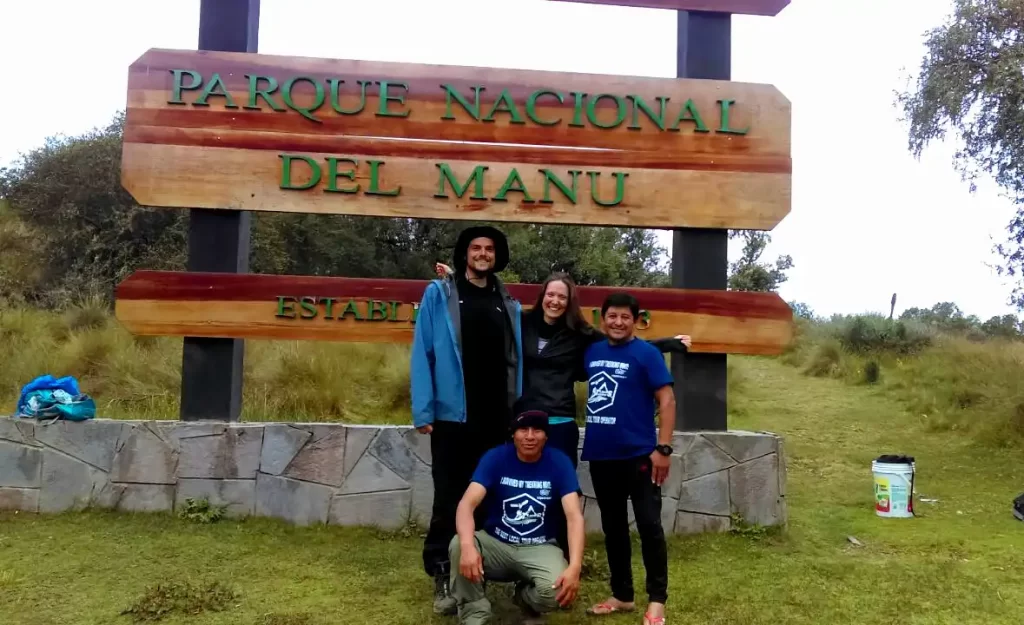
Further along, the route passes waterfalls close enough to the road to feel the spray in wetter conditions, and crosses the official entrance checkpoint into the park’s protected area before the road ends at Atalaya.
What to Expect on Travel Day
The drive from Cusco to Atalaya takes roughly
To confirm our current standard drive time against actual road conditions, you should expect the total transit from Cusco to our initial jungle lodge to span 8 to 10 hours. We divide this demanding journey into distinct segments to keep it comfortable. The first 2 to 3 hours are on paved roads up to Paucartambo, where we stop for breakfast.
The remaining 6 to 7 hours involve navigating the narrow, unpaved descent through the cloud forest to the Atalaya port. In line with our strict company policy to manage all ground logistics while entirely excluding airplane flights, we operate our own well-maintained private transport.
We always leave Cusco before dawn to ensure we reach our destination safely with plenty of daylight to spare.
Depending on wildlife stops and road conditions, followed by the boat transfer down to Boca Manu. Departure is typically early — well before dawn — both to make the most of daylight for the drive and because wildlife activity in the cloud forest peaks in the first hours of morning.
Expect the terrain to shift from paved mountain highway to narrow, unpaved roads hugging the mountainside as you descend. Fog is common in the cloud forest section, and an experienced local driver familiar with the specific curves and conditions matters more here than on almost any other route in this region.
The Mistakes We See Most Often
The most common one is assuming this is a single continuous drive all the way into the park. It isn’t — the Reserved Zone requires the boat transfer from Atalaya, and travelers who don’t plan for that transition, both logistically and in terms of what to pack for a boat versus a vehicle, sometimes arrive underprepared for the second leg.
The absolute most common mistake our guides witness on this specific overland route is travelers completely underestimating the winding nature of the Manu Road, leading to severe motion sickness. The descent from the Andes into the Amazon involves hundreds of tight hairpin turns on unpaved switchbacks.
Even clients who do not typically suffer from car sickness often find themselves incredibly nauseous, which completely ruins their first day of wildlife spotting.
Our operational advice is straightforward: if you are even slightly prone to motion sickness, bring your trusted medication and take it before we depart Cusco.
We also seat those affected at the front of our private vans, but preventative medication is your best defense.
The second is skipping acclimatization in Cusco beforehand. The route’s highest pass sits well above 3,500 m (11,480 ft), and travelers who arrive in Cusco and head straight out on this route without 2–3 days to adjust are taking on real altitude risk before the trip even reaches its most demanding driving section.
The third is packing only for jungle heat and getting caught out by the temperature swing — freezing at the pass in the morning, humid and hot by afternoon in the lowlands. Layers aren’t optional on this specific route; the swing is more extreme than on most single-day trips in Peru.
FAQs
Can you actually drive all the way from Cusco to Manu National Park? No — the road ends at Atalaya. Reaching the Reserved Zone and Boca Manu requires a boat down the Alto Madre de Dios River, since there’s no road access into that part of the park.
How long does the drive from Cusco to Atalaya take? When quoting drive times from Cusco to our lodges in the Cultural Zone or the Atalaya river port, we never give a fixed, guaranteed number. In our operational experience, this journey typically takes between 8 and 10 hours.
However, the Manu Road is a winding, unpaved route carved into the side of the Andes, and conditions are highly variable. Unexpected rainfall, minor landslides, or passing heavy cargo trucks can easily add an hour or two to the trip.
Our private vans prioritize safety above speed, and our guides intentionally break up the drive with strategic stops for wildlife spotting, photography, and meals. We ask our clients to treat this overland journey as an integral part of the safari, not just a transit day.
Is the road trip safe? Traveling with an experienced local driver on adapted vehicles matters significantly on this route, given narrow, unpaved sections and frequent fog in the cloud forest, especially on curves with limited visibility. This is not a route to attempt independently or with an unfamiliar driver.
What do people ask you most before booking this route? The question our operations team gets most frequently on WhatsApp regarding the Cusco-to-Manu route is: “Is the road really as terrifying and dangerous as the internet makes it out to be?” Many blogs sensationalize the sheer drops of this descent.
We always reassure our clients with operational facts. Yes, it is a narrow, high-altitude dirt road, but we mitigate those risks entirely through strict safety protocols.
We exclusively use our own private, rigorously maintained vehicles driven by full-time staff who navigate this specific route weekly. We never use overworked, contracted drivers, and we only travel during daylight hours.
When you travel with an experienced agency, the drive is a spectacular, safe adventure, not a terrifying ordeal.
Will I get altitude sickness on this route? Altitude risk is real given the high pass early in the trip. Spend 2–3 days acclimatizing in Cusco beforehand, and speak with a travel clinic if you have any underlying heart or lung condition — this isn’t something a road-trip guide can advise on safely.
Next Step
Once you understand the road-to-boat structure of getting there, the next step is deciding what you’re most hoping to see once you arrive. Our complete guide to the animals of Manu and our birdwatching guide to Manu National Park both cover what to realistically expect once you’re past this journey. For the park’s full background and zone regulations, see our Manu National Park: The Definitive Guide. We’re also building a dedicated guide to the best season for this specific route — not live yet, but worth checking back for. When you’re ready to book, our Manu Reserved Zone 6-day, 5-night tour includes this journey as part of the itinerary.