The real difference between the three itineraries, in one line
Ausangate is the highest-sustained-altitude trek in the Cusco region, well above the Inca Trail’s elevation profile, and the extra days in the 6-day and 7-day versions aren’t padding — they buy you more high passes, a fuller loop around the mountain, and, on two of the three itineraries, the Pacchanta hot springs as a finish. The 4-day version gives you a genuine taste of the circuit without the full commitment; the 6-day completes the loop around the mountain; the 7-day adds breathing room at altitude rather than new terrain. For the fuller picture of the mountain and the region before picking a length, our ultimate Ausangate trekking guide is worth reading first.
Comparing all three itineraries
| 4 days / 3 nights | 6 days / 5 nights | 7 days / 6 nights | |
|---|---|---|---|
| Approximate distance | Roughly 35-40 km | Roughly 55-65 km | Roughly 60-70 km |
| Passes above 4,800 m | 1-2 | 3-4 | 3-4, at a more spread-out pace |
| Maximum altitude | Around 4,950-5,000 m | Around 5,200 m (Palomani Pass) | Around 5,200 m (Palomani Pass) |
| Includes Vinicunca | Sometimes, as a partial detour | Yes, as a full day | Yes, as a full day |
| Includes Pacchanta hot springs | Not always — check the specific itinerary | Yes, typically the closing camp | Yes, typically the closing camp |
| Camping | Yes, throughout | Yes, throughout | Yes, throughout, with an extra acclimatization or rest day |
| Difficulty | Demanding, shorter exposure to high altitude | Demanding, sustained days above 4,800 m | Demanding, same terrain with more recovery time |
| Indicative price range | Lowest of the three | Mid-range | Highest of the three |
Check current pricing and departure dates on the tour pages for the 4-day, 3-night trek, the 6-day, 5-night trek, and the 7-day, 6-night trek.
The 4-day version: what it covers and what it skips
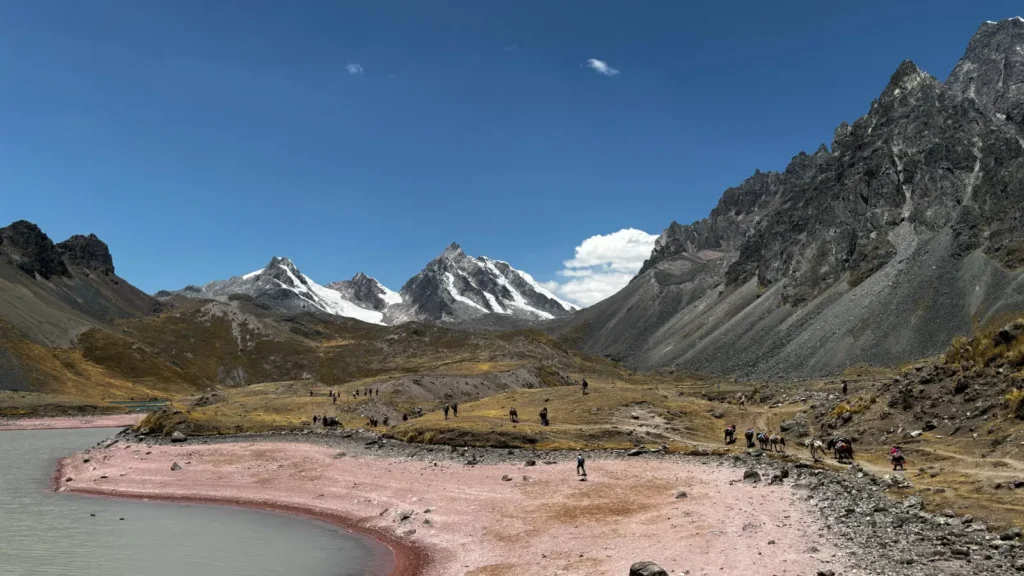
The 4-day itinerary gets you into the Ausangate massif and over at least one high pass, typically in the 4,800-5,000 m range, with glacial lakes and alpaca herds along the way — the core visual identity of the trek is all there. What it doesn’t do is complete the loop around the mountain; it’s a targeted slice of the circuit rather than the full route, so some of the more remote lakes and the second or third high pass that the longer versions cross don’t make it into four days. Whether Vinicunca and Pacchanta are included depends on the specific route variant, so this is worth confirming directly on the tour page rather than assuming either is automatic. If your priority is a real taste of high-altitude Ausangate scenery without committing to six or seven days, this is the itinerary built for that.
The 6-day version: the full loop around the mountain
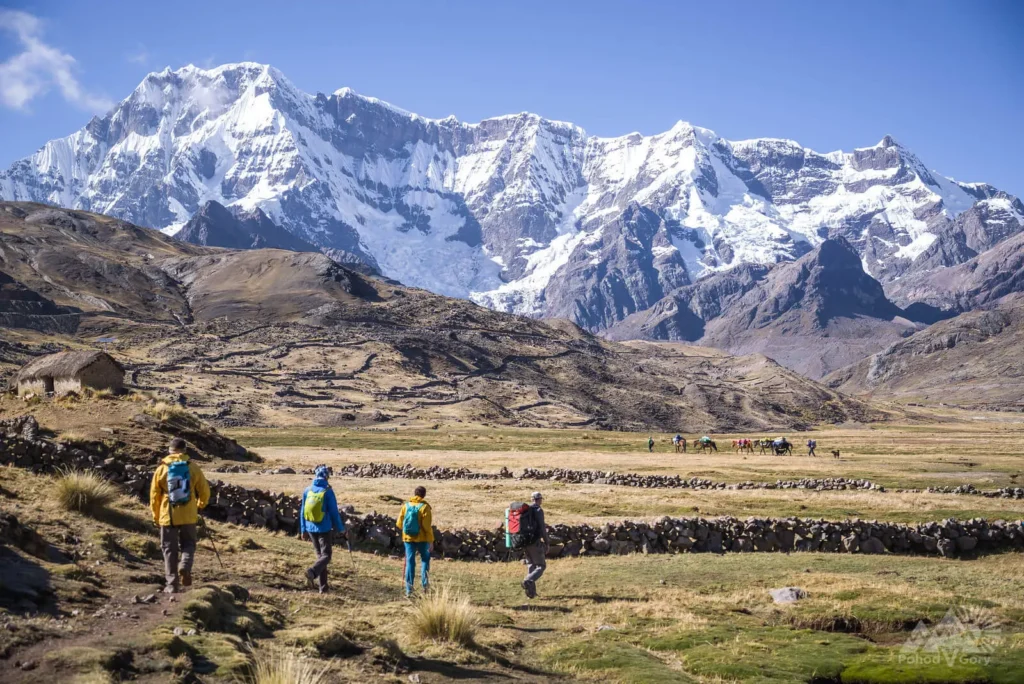
Six days is generally what it takes to complete the circuit around Ausangate rather than cutting through part of it, crossing multiple passes above 4,800 m, including the Palomani Pass near 5,200 m, the trek’s highest point on most route variants. Our 6-day Ausangate and Vinicunca trek covers this itinerary’s day-by-day breakdown directly. This version typically closes with Vinicunca as a dedicated day and ends the trek at the Pacchanta hot springs, giving the trip a clear finish point rather than an abrupt return to the trailhead.
The 7-day version: what the extra day actually adds
The seventh day doesn’t add new terrain so much as it adds room to breathe at altitude — an extra acclimatization or lower-intensity day built into the same route the 6-day version covers, which reduces how many demanding, multi-pass days get stacked back to back. For trekkers who felt strong on a previous high-altitude trip but want less physical stress day to day, or for anyone who wants a buffer built in for slower mornings or unpredictable weather, this extra day is where that flexibility comes from rather than from seeing something the 6-day itinerary misses. If you specifically want a full day dedicated to the lake system beyond the standard circuit stops, our guide to the 7 lakes of Ausangate covers that extension, and the standalone 7 Lagoons of Ausangate day trip is worth knowing about if you want that specific lake system without committing to any multi-day version.
The high passes, one by one
The passes are where this trek separates itself from almost everything else near Cusco. Depending on the exact route and direction taken, trekkers typically cross an initial pass in the 4,800-4,950 m range early in the circuit, followed by Palomani Pass, generally the trek’s highest point at around 5,200 m, and on longer itineraries a further pass in the 5,000-5,100 m range later in the route. Each one feels different: the first pass is often the hardest simply because your body hasn’t adjusted yet, even if a later pass sits at a higher absolute elevation. Our guides notice trekkers slow dramatically in the final stretch below each pass, where the combination of thin air and a final push of elevation gain hits hardest — this is completely normal and not a sign anything has gone wrong.
Acclimatization is not optional here
Spending at least 2 to 3 full days in Cusco before starting is the standard recommendation for this trek, and at Ausangate’s altitudes that’s closer to a requirement than a suggestion. The remoteness of the circuit means evacuation from deep inside the route can take several hours, which makes arriving under-acclimatized a real risk rather than just a comfort issue. Our guide to managing altitude sickness in Cusco covers how to use those days effectively before you start trekking, not just how to survive them.
What the cold actually feels like
Nighttime temperatures on this trek regularly drop below freezing, and at the higher camps it’s common for water left in bottles overnight to have a layer of ice by morning. This isn’t an occasional cold snap — it’s the expected nightly pattern throughout the trekking season, so a sleeping bag rated for well below freezing matters more here than on almost any other trek in the region. Days can feel warm in direct sun at altitude, which makes the swing between midday warmth and post-sunset cold catch people off guard if they haven’t packed for both extremes.
Why the Pacchanta hot springs close the circuit so well
Ending the trek at Pacchanta means the last night is spent near natural hot springs with a direct view of the Ausangate glacier, which turns the final stretch of a demanding, cold, high-altitude trek into a genuinely restorative finish rather than just another camp. It’s also a practical closing point logistically, since Pacchanta connects reasonably well to the return transport to Cusco, making it a natural place to end rather than an add-on detour.
Ausangate versus other treks in the region
Compared to the Inca Trail, Ausangate reaches significantly higher elevations and sustains that altitude across more of the trek, without any permit system or daily quota limiting availability — the trade-off is a colder, more physically demanding route with less cultural infrastructure along the way. If Vinicunca specifically is your main goal rather than the full circuit, it’s worth knowing you can visit it as a standalone day trip from Cusco, and our complete guide to Rainbow Mountain covers that shorter option directly, alongside what makes the full Ausangate circuit a genuinely different experience from a single-day visit.

Which version to choose based on your experience
If you’ve never trekked above 4,500 m before, the 4-day version is a more honest test of how your body handles this altitude before committing to a longer route, and it still delivers the core Ausangate scenery. If you’ve done high-altitude trekking previously and handled it well, the 6-day version is the standard choice, completing the full circuit with Vinicunca and Pacchanta included. If you want the same circuit with less day-to-day physical stress — whether due to a slower pace, less recent trekking experience, or simply wanting more margin for bad weather — the 7-day version gives you that buffer without changing the route itself. Whichever length you pick, proper footwear matters more here than on lower-altitude treks; our guide to choosing hiking boots covers what to look for, and if you’re deciding whether trekking poles are worth carrying at this altitude and terrain, our article on whether trekking poles are worth it applies just as directly here as it does on the Inca Trail.
Frequently asked questions
How many 5,000 m passes does each Ausangate itinerary cross? The 4-day version typically crosses one to two passes above 4,800 m. The 6-day and 7-day versions cross three to four, including Palomani Pass at around 5,200 m, the trek’s highest point on most route variants.
Does the 4-day Ausangate trek include Vinicunca? It depends on the specific route variant, so this isn’t automatic on every 4-day itinerary. Confirm directly on the tour page before booking if Rainbow Mountain is a priority for you.
Which itinerary ends at the Pacchanta hot springs? The 6-day and 7-day versions typically close at Pacchanta, using the hot springs as the final camp before returning to Cusco. Whether the 4-day version includes Pacchanta depends on the specific route.
How cold does it get at night on this trek? Temperatures regularly drop below freezing at the higher camps, often enough to freeze water left in bottles overnight. A sleeping bag rated for well below freezing is standard gear for this trek, not an optional upgrade.
How many days of acclimatization do I need before starting? At least 2 to 3 full days in Cusco beforehand is the standard recommendation, and at Ausangate’s altitudes that’s closer to a requirement than a suggestion, given how remote parts of the circuit are.
Is Ausangate harder than the Inca Trail? In terms of altitude, yes — Ausangate reaches significantly higher elevations and sustains that altitude across more of the trek than the Inca Trail does. It also has no permit system or daily quota, unlike the Inca Trail.
What does the extra day add in the 7-day version compared to the 6-day one? It mainly adds recovery time rather than new terrain — an additional acclimatization or lower-intensity day spread across the same circuit, which reduces how many demanding, multi-pass days are stacked consecutively.