If a jaguar sighting is the trip’s lottery ticket, monkeys are the sure thing. Manu is home to more than 14 primate species, and unlike the big cats, they’re seen on nearly every trip, often multiple times a day. This guide covers who you’re likely to spot, where and when to look, and how to watch them responsibly. For the wider destination context, see our complete Manu Reserved Zone guide.
The Primates You’re Most Likely to See
Spider monkeys. Long limbed, with a strong prehensile tail that works almost like a fifth hand, spider monkeys are the acrobats of the canopy. They travel in active groups high in the trees, swinging between branches, and play an important role as seed dispersers for the forest. Look for them overhead on trail walks, moving fast and rarely staying still.
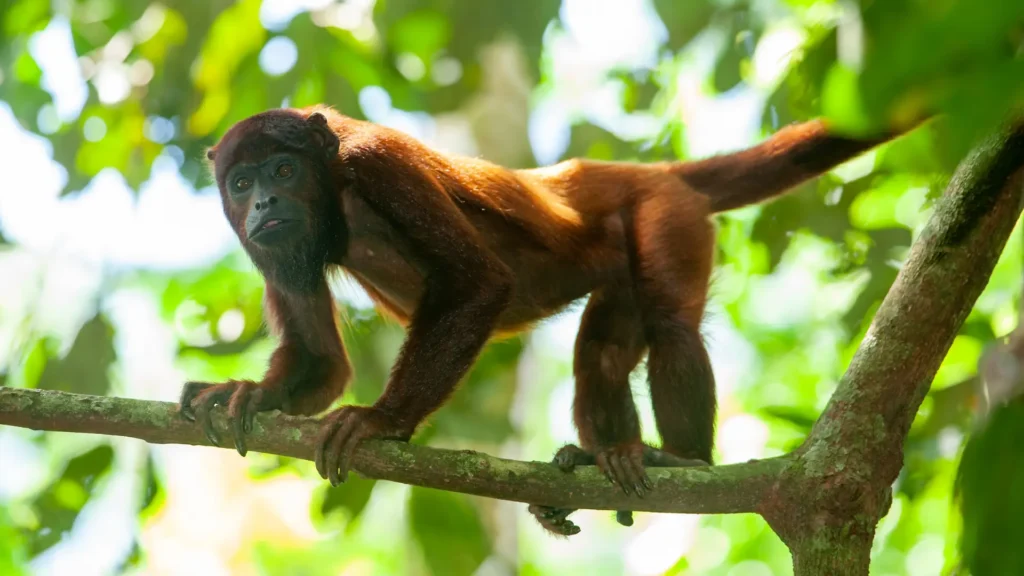
Red howler monkeys. You’ll hear these before you see them. Their deep, guttural roar carries for miles through the forest, especially at dawn, and it’s genuinely one of the sounds most travelers remember from the entire trip. Howlers tend to stay higher in the canopy and move less than spider monkeys, so once you locate the sound, patience is what gets you the visual.
Capuchins. Smaller and notably curious, capuchin troops move through the mid-canopy and are often seen from the river as well as from trails. They tend to travel in larger, more active groups than howlers, which makes them one of the easier species to catch in motion.
Tamarins. Small, fast-moving, and usually seen in tight family groups, tamarins favor lower and mid-canopy levels, which sometimes puts them closer to eye level than other species. Their calls are higher pitched and less overpowering than a howler’s.
Pygmy marmosets. The smallest monkey species in the world, pygmy marmosets are also the hardest to spot: tiny, quick, and easy to miss unless a guide already knows where a family group is active. Seeing one is a genuine highlight precisely because it isn’t guaranteed.

Where and When You’ll See Them
Primates show up in three main contexts: from the boat along the riverbanks, on foot along jungle trails, and overhead in the canopy at both. Activity peaks early, generally between 5:30 and 7:00 AM, and again in the late afternoon, so expect early wake-up calls built into the itinerary if primate sightings are a priority for you. Outside those windows, the heat of midday tends to push most species into rest.
Often the first sign of a troop isn’t a sighting at all, it’s sound: falling fruit, snapping branches, or leaves shaking well before anything comes into view. Guides learn to read those cues before pointing binoculars anywhere.


The Howler’s Dawn Call
Waking up to a red howler troop calling at first light is one of those experiences that’s hard to describe until you’ve heard it. The sound is loud enough to seem close even from a considerable distance, and it sets the tone for the rest of the day’s wildlife watching. If nighttime sounds are as much a part of the appeal for you as daytime sightings, our Manu night walk guide covers what else is active once the sun goes down.
Respecting the Troop: Our Approach to Wildlife Viewing
None of this works if animals are disturbed or habituated to people. We don’t feed wildlife, don’t use calls or sounds to draw animals closer, and keep a respectful distance at all times, even when a closer shot would be tempting. This isn’t just an ethics statement, it’s part of a broader commitment: our social responsibility practices and how we operate as an environmentally responsible operator both shape how our guides run every wildlife encounter.
Practical Facts for Your Trip
Altitude on the overland route runs from around 4,000 m (13,123 ft) crossing the Andes down to roughly 300 m (984 ft) in the lowland jungle where most primate sightings happen. Expect hot, humid tropical conditions, with daytime temperatures between 25°C and 35°C (77°F to 95°F). The dry season, May to October, is the best time to visit: trails are less muddy and animals gather more predictably around water sources. Bring quality binoculars, a telephoto lens if you want photos, lightweight breathable clothing, and a reusable water bottle. If you’re arriving from Cusco, plan on 2 to 3 days there first; our guide on managing altitude in Cusco covers how to acclimatize properly before the overland crossing.
More to See Beyond Monkeys
Primates are just one part of what makes Manu worth the trip. Our broader guide to Manu’s wildlife covers the fuller picture, from birds to mammals to reptiles, and if you want the full packing rundown before you go, our jungle packing checklist has you covered beyond just binoculars.
See Manu’s Primates for Yourself
Nearly every itinerary into Manu delivers strong primate sightings, since they’re active daily rather than a rare event. Our 6-day, 5-night Manu Reserved Zone tour gives enough time in the field to see several species across different habitats, from riverbank capuchins to canopy spider monkeys.
Frequently Asked Questions
What monkey species will I actually see in Manu? Spider monkeys, red howler monkeys, capuchins, and tamarins are the most consistent sightings. Pygmy marmosets are possible but harder to find due to their small size.
What time of day are monkeys most active in Manu? Early morning, roughly 5:30 to 7:00 AM, and again in the late afternoon. Midday heat tends to reduce activity across most species.
Why do howler monkeys make such a loud sound? It’s a territorial and communication call that can carry for miles through dense forest, which is why you’ll often hear a troop well before spotting one.
Are monkeys in Manu seen from the boat, on trails, or both? Both. Some species like capuchins are commonly seen from the river, while others are more consistently spotted on foot along jungle trails or overhead in the canopy.
Is it okay to try to attract monkeys closer with food or calls? No. We don’t feed wildlife or use calls to draw animals in, since it disrupts natural behavior and can create dependency on human contact.
What is the smallest monkey species found in Manu? The pygmy marmoset, the smallest monkey species in the world. It’s also one of the hardest to spot due to its size.
Do I need special gear to see monkeys well? Quality binoculars make the biggest difference, since most sightings happen at a distance in the canopy. A telephoto lens helps if photography is a priority.