Reaching Machu Picchu is a dream for thousands of travelers, but when planning the adventure, a big question arises: Which route should I choose? If you are looking to challenge your limits, you probably find yourself in the middle of the salkantay vs inca trail debate.
Both treks are spectacular and rank among the best trekking routes in the world, but they offer very different experiences and levels of demand.
At Local Trekkers Peru, we have guided hundreds of adventurers along these trails and we know that the right choice depends on your physical preparation, your tastes, and above all, what kind of challenge you are looking for. Below, we analyze in depth which of the two is truly the most difficult.
Contents
The Classic Inca Trail: History and Infinite Stairs
The Inca Trail is legendary. It is the only route that allows you to arrive walking directly to the Sun Gate (Intipunku) to watch the sunrise over Machu Picchu. But don’t let its popularity fool you; the inca trail difficulty is real and often surprises the unprepared.
Why is it difficult?
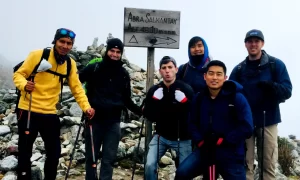
The main enemy here is not always the distance, but the stairs. The second day is known as the toughest due to the ascent to the Dead Woman’s Pass (Warmiwañusca) at 4,215 m.a.s.l.
- Terrain: Irregular, with thousands of original stone steps (often high and steep).
- Impact: It is a demanding route for the knees and legs.
- Logistics: It is strict. Pre-established campsites and a set pace.
The Salkantay Trek: Extreme Altitude and Wild Nature
If the Inca Trail is history, Salkantay is nature in its purest form. When looking for salkantay trekking reviews, you will notice that travelers highlight the vastness of the landscapes and the sense of isolation.
Why is it difficult?
Here the challenge is altitude and endurance. You will walk more kilometers per day and reach a higher elevation than on the Inca Trail.
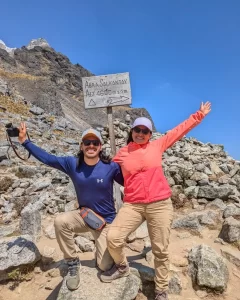
- Highest point: The Salkantay Pass is at 4,630 m.a.s.l. (almost 400 meters higher than the highest point of the Inca Trail).
- Climate: More extreme. You go from freezing cold at the pass to hot humidity in the high jungle in a matter of hours.
- Terrain: Dirt, gravel, and loose rock paths. Fewer stairs, but steep slopes.


Salkantay vs Inca Trail: Comparison of Key Data
To help you better visualize the challenge, we have prepared this comparison table with technical data that every traveler should know:
| Feature | Classic Inca Trail (4 Days) | Salkantay Trek (5 Days) |
| Total Distance | 43 km (approx.) | 74 km (approx.) |
| Maximum Altitude | 4,215 m (Warmiwañusca) | 4,630 m (Salkantay Pass) |
| Difficulty | Moderate – High (Technical due to stairs) | High (Physical due to altitude and distance) |
| Accommodation | Tent camping | Campsites, Domes, or Lodges |
| Permits | Sold out 6 months in advance | Flexible (daily availability) |
Landscapes and Visual Experience: What will you see on each route?
Difficulty isn’t everything; the visual reward is what keeps you walking.
On the Salkantay Trek, variety is the protagonist. The salkantay landscapes take you from the slopes of a sacred peak (Apu Salkantay) and turquoise lagoons like Humantay Lake, to coffee plantations and tropical cloud forests. It is ideal for nature photography lovers.
On the other hand, the Inca Trail is a journey back in time. You will walk on original stone paving and cross multiple archaeological sites like Wiñay Wayna and Sayacmarca, which are only accessible by foot. It is the perfect choice for history and mysticism lovers.


Expert Tips from Local Trekkers Peru
As local experts, we want your experience to be unforgettable and safe. Here are our golden tips for either route:
- Acclimatization is Non-Negotiable:Arrive in Cusco at least 2 or 3 days before your trek. Your body needs to adapt to the altitude to avoid altitude sickness, especially if you choose Salkantay.
- Train Specifically:
- For Inca Trail: Practice going up and down stairs with weight on your back. Your knees will thank you.
- For Salkantay: Focus on long cardiovascular endurance walks and leg strengthening.
- The Right Footwear:Never wear brand-new boots on the trek. Use them at least a month before. They should be waterproof and have good ankle support.
- Trekking Poles:Regardless of your age or physical condition, poles are vital. They reduce the impact on the knees by up to 20%, crucial on the steep descents of both routes.
Conclusion: What is the verdict?
So, in the salkantay vs inca trail battle, which is harder?
Physically, the Salkantay Trek is harder due to the higher altitude, more intense cold at the summit, and the total distance, which is almost double that of the Inca Trail. It requires greater cardiovascular endurance.
However, the Inca Trail can feel more muscularly painful due to the thousands of stone steps that punish the joints.
If you are looking for the classic entrance and love history, the Inca Trail is for you (book months in advance!). If you are looking for a greater physical challenge, wild landscapes, and imposing glaciers without worrying about sold-out permits, Salkantay is your best option.