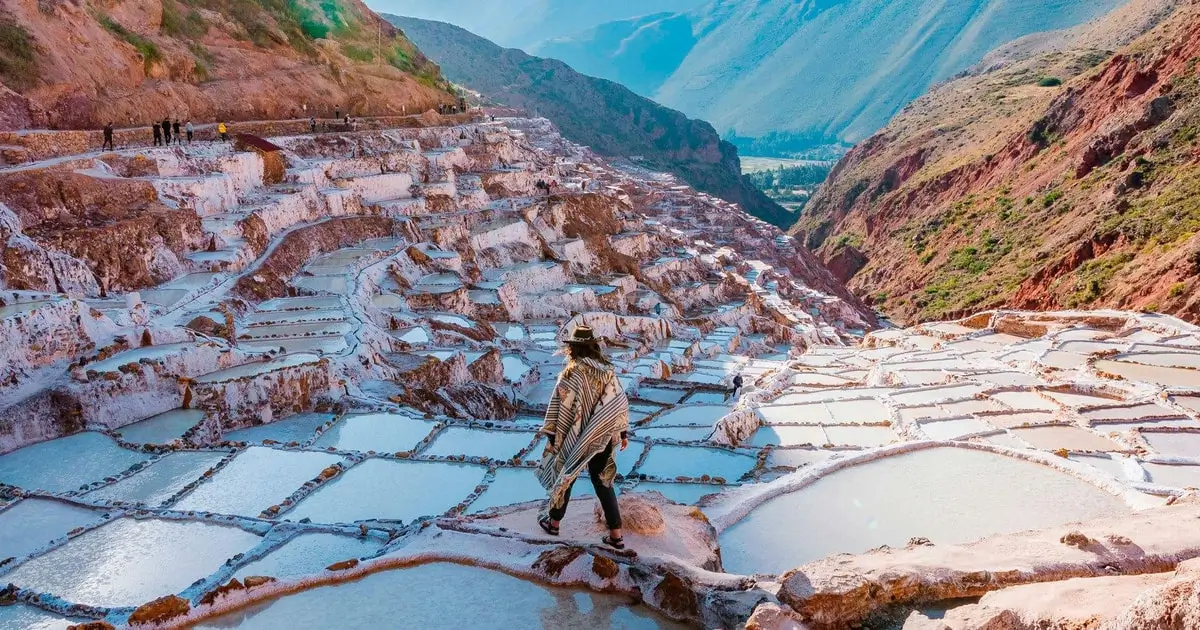
Here’s the thing almost no article tells you plainly: since 2019, you can’t walk down among the salt pools at Maras anymore. The famous shot of someone standing between hundreds of white and ochre terraces, salt crusted at their feet? That’s a viewpoint photo now, not a walk-through experience. If you’re picturing the classic postcard image, it’s worth knowing upfront, because a lot of visitors arrive expecting to wander the pools and leave a little deflated when they can’t. Once you know that going in, Maras and Moray are still genuinely worth the trip — you just need to reset the expectation before you go, ideally as part of a broader look at the best day tours from Cusco so you know where these two sites fit into your itinerary.
The second thing most guides get wrong, or skip entirely, is what Moray actually was. It’s often billed as a ceremonial amphitheater, which sounds dramatic but isn’t the leading explanation among researchers. The more accepted interpretation is more interesting than the myth: Moray was likely an agricultural laboratory, using its circular terraces to create a stack of different microclimates for testing crops. Let’s go through both sites properly.
What Are the Salineras de Maras?
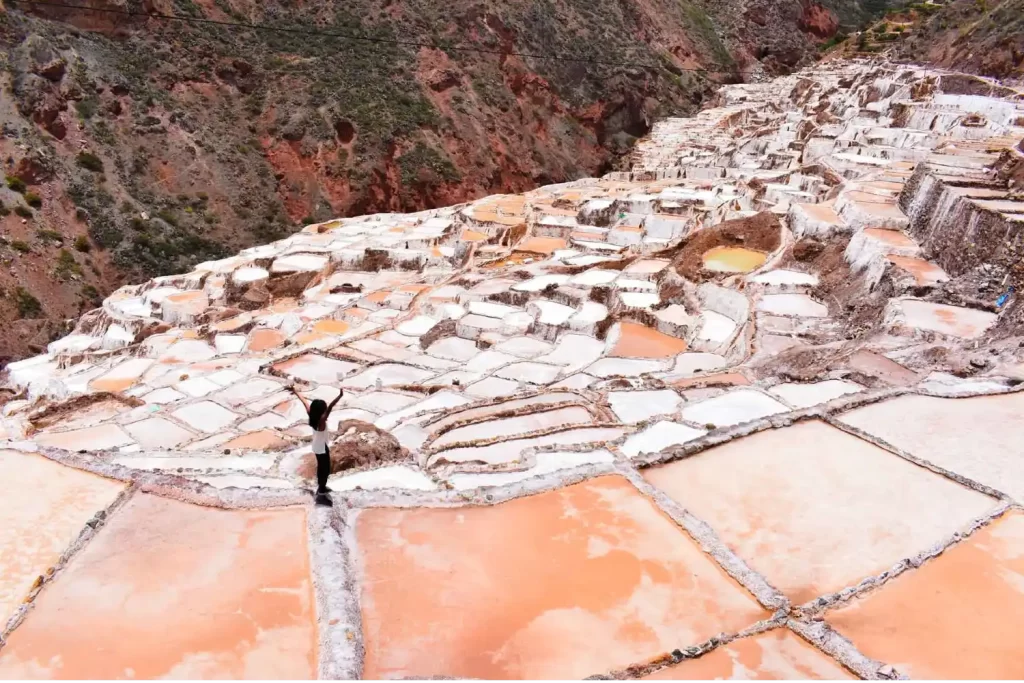
The Salineras (salt pans) of Maras sit on a hillside below the town of Maras, fed by a naturally salty spring that has flowed out of the mountain since long before the Incas — some estimates put the site’s origins in the pre-Inca period. The water runs down through a network of small channels into roughly 3,000 individual pools, each one just a few square meters, terraced down the slope in a dense honeycomb pattern.
The salt isn’t a museum piece. It’s a working, family-run operation today, exactly as it has been for generations: local families own or lease individual pools, and they manage the entire cycle by hand — channeling in the mineral-rich water, letting it evaporate under the sun, and scraping out the salt crystals that form on the pool floor. What you’re looking at isn’t a preserved ruin; it’s an active harvest, still run by the same communities that have worked it for centuries.

What You Can and Can’t Do Today
Here’s the practical part. As of 2019, walking down into the terraces themselves is no longer allowed. Visitors view the pools from a designated overlook path along the upper edge of the site, which still gives a full, sweeping view of the terraces cascading down the hillside — it’s a genuinely striking sight, just from above rather than from within.
The restriction exists because foot traffic was damaging the pool walls and interfering with the harvest itself; this is still a working business for the families who depend on it, not a static attraction. So plan your photos accordingly: the wide shot from the viewpoint is spectacular, but the “standing between the pools” shot isn’t part of the current visit. Knowing this ahead of time saves the disappointment on-site.
Moray: Not an Amphitheater, an Agricultural Laboratory
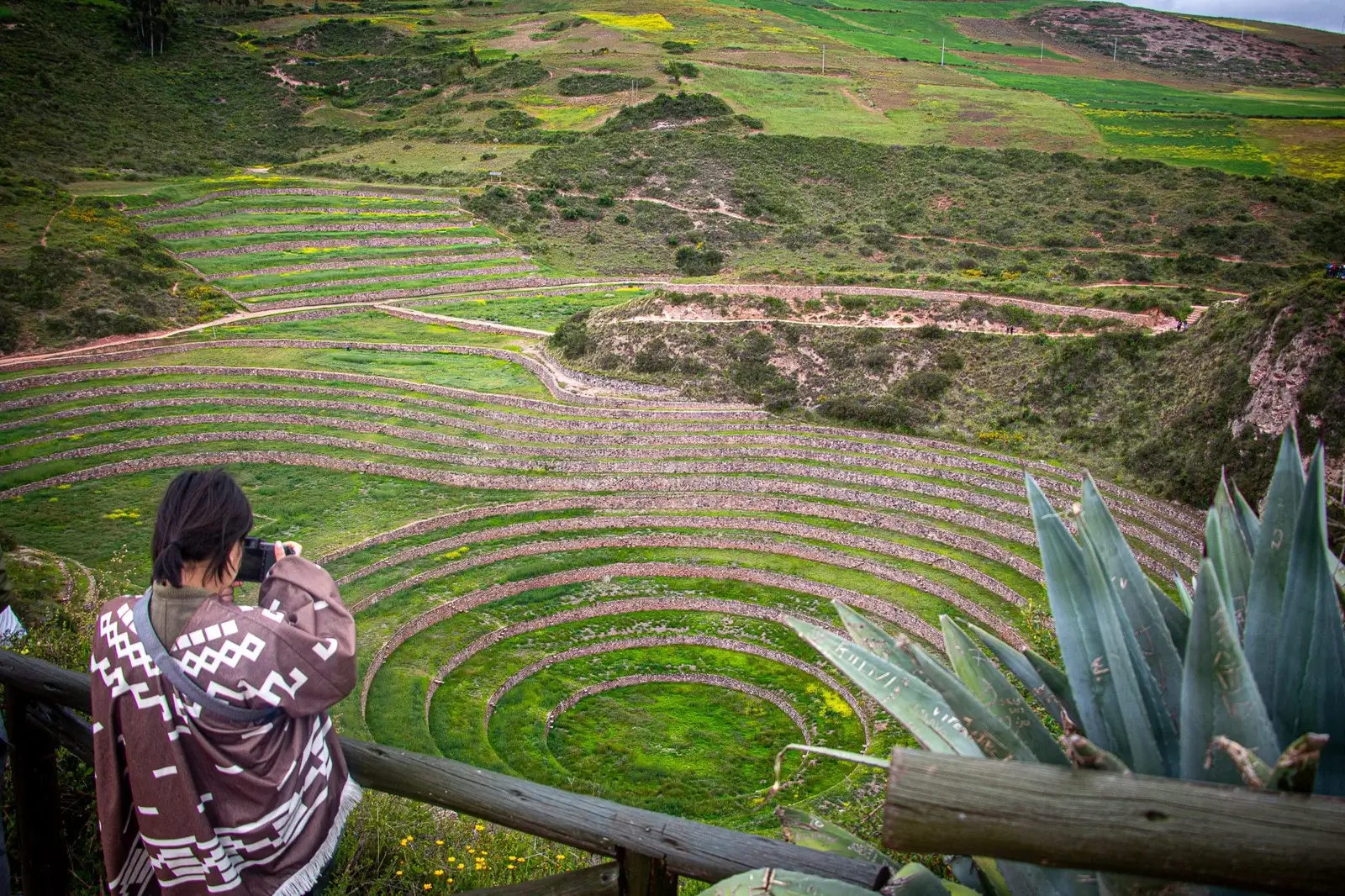
About 30 minutes from Maras, Moray is a set of enormous circular terraces cut into a natural depression in the earth, sometimes compared to an amphitheater because of the shape. That comparison is where the ceremonial theory comes from — but most archaeologists now favor a different explanation.
The terraces descend in concentric rings, and each level down sits in a slightly different microclimate: temperature differences between the top ring and the bottom of the deepest depression can run several degrees Celsius, sometimes cited at up to 15°C (about 27°F) between the highest and lowest points, along with differences in humidity and sun exposure at each tier. That range roughly mimics the climate variation you’d find across a large stretch of elevation in the Andes — from valley floor to high mountain slope — compressed into a single site a few hundred meters across.
The leading theory is that the Incas used Moray as an experimental agricultural station, testing which crop varieties thrived at which micro-elevation before deciding what to plant where across their empire. It’s a compelling piece of engineering as much as farming — worth reading in more depth in our dedicated guide to Moray, the mysterious agricultural laboratory of the Incas.
Tickets: The Number One Point of Confusion
This trips up more visitors than anything else about these two sites, so it’s worth being direct about it: Maras and Moray are covered by two completely different ticket systems.
- Maras (the salt pans) requires its own separate entrance fee, paid on-site. It is not included in the Cusco Tourist Ticket (Boleto Turístico) in any version.
- Moray is included in the Cusco Tourist Ticket — specifically the Circuit that covers the Sacred Valley sites, available as part of the Partial or the General ticket. If you already hold either of those, Moray’s entrance is covered; Maras still isn’t.
If you’re buying the tourist ticket for other Sacred Valley or Cusco sites anyway, it’s worth reading our complete guide to the Cusco Tourist Ticket (BTC) before you go, so you know exactly what it does and doesn’t cover and don’t get caught paying twice — or short at the Maras gate expecting your BTC to work there.
Altitude, Weather and Best Time of Day
Both sites sit close to the Sacred Valley’s typical elevation range: Maras is around 3,300 meters, and Moray a bit lower at roughly 3,500 meters at its rim — high enough that altitude is still a factor if you’re only a day or two into your trip. If you’ve just landed in Cusco, it’s worth pacing your first days properly; our first-3-days acclimatization itinerary walks through how to sequence excursions like this one so you’re not tackling it while still adjusting.
For light and crowds, early morning is the sweet spot — tour buses from Cusco tend to arrive at Moray and Maras from mid-morning onward, so getting there before 9:30–10am usually means fewer people and softer light for photos, especially at Maras where the pools catch morning sun at a good angle. Afternoons can bring stronger wind and, depending on the season, rain clouds rolling in over the valley.
How to Get There
There are three realistic ways to visit:
Full-day tour combined with the Sacred Valley. This is the most common option, and for good reason: Maras and Moray sit close enough to Ollantaytambo, Urubamba, and Pisac that a well-organized full-day Maras, Moray and Sacred Valley tour lets you cover all of it without backtracking, with transport, a guide, and logistics handled.
Quad bike (ATV). For a more active, hands-on way to reach both sites, a half-day quad bike tour to Maras and Moray covers the dirt roads and open countryside between the two, which is a genuinely fun way to do the route if you want something more adventurous than a bus. Our dedicated guide to quad biking Maras and Moray covers what to expect, fitness level needed, and what’s included.
On your own. It’s possible to reach both sites independently by combi (shared van) from Cusco to Maras town and a taxi or moto-taxi from there, but it takes more time, more coordination between stops, and you’ll be arranging entrance tickets and transport separately at each point. It works if you have flexible time and enjoy independent travel, but it’s the slowest option of the three.
What to Bring
- Sun protection: hat, sunglasses, high-SPF sunscreen — the altitude means stronger UV exposure even on cloudy days
- Layers: mornings can be cold, midday sun is strong, and wind picks up in the afternoon
- Comfortable walking shoes with grip, since the paths around both sites are uneven dirt and stone
- Cash in small soles bills for the Maras entrance fee and any local snacks or crafts
- Water, since there’s limited shade at either site
A Few Other Sacred Valley Stops Worth Knowing About
If Maras and Moray are part of a longer Sacred Valley day, it’s worth knowing what else is nearby: the market and ruins at Pisac, and the living Inca town of Ollantaytambo, which still functions as an inhabited settlement built directly on Inca foundations. For a broader overview of what’s worth prioritizing across the valley, see our guide to 15 essential locations to visit in the Sacred Valley.
FAQ
Can I still walk into the salt pools at Maras? No. Since 2019, access into the terraces is restricted; visitors view the site from an overlook path above the pools.
Does the Cusco Tourist Ticket cover Maras? No. Maras has its own separate entrance fee, paid on-site, and isn’t included in any version of the Boleto Turístico.
Does the Cusco Tourist Ticket cover Moray? Yes, Moray is included in the Sacred Valley circuit, available with the Partial or General versions of the ticket.
How much time do I need for both sites? Most visitors spend 45 minutes to an hour at each site — enough to walk the viewpoint at Maras and the rim trail at Moray without rushing.
Is Moray really a ceremonial amphitheater? That’s the popular theory because of its shape, but most researchers now favor the agricultural laboratory explanation based on the microclimate differences between terrace levels.
Can I visit Maras and Moray without a tour? Yes, by combi and taxi from Cusco or Maras town, though it takes longer and requires more coordination than a guided tour or quad bike option.