What the Name Actually Means
Huchuy Qosqo translates from Quechua as “Little Cusco,” but that’s not what the Incas called it. The name is a later label, applied because the layout and stonework echo the imperial capital on a smaller scale, not because the site was ever officially a second Cusco. Its original Inca name hasn’t survived in any reliable record.
That naming confusion is part of why so few travelers know what Huchuy Qosqo actually was. Ask about the huchuy qosqo inca ruins in Cusco and you’ll usually get a vague answer about “another Pisac” or “a smaller Machu Picchu,” neither of which is accurate. It was a royal residence with its own specific history, and that history is what this guide covers, not the trek itself.
The Historical Context: Wiracocha, the Chanka Threat, and a Royal Refuge
Most sources attribute Huchuy Qosqo to Wiracocha Inca, the eighth Sapa Inca, who is generally credited with ordering its construction as a retreat and estate above what’s now the town of Lamay. This part is reasonably well established in the archaeological and chronicle record.
What’s less settled is the exact role the site played during the Chanka threat, the conflict that nearly overran Cusco before Wiracocha’s son, Pachacuti, took command and defeated the invaders. Some chroniclers describe Wiracocha withdrawing from Cusco during that crisis, and Huchuy Qosqo is sometimes named as a possible refuge during that period, but this is closer to informed interpretation than settled fact, the written sources on this specific episode are inconsistent. If you want the fuller sweep of how the empire expanded and where episodes like this fit into it, our guide to Inca Empire history covers that broader arc.
What is clear is the site’s function: a royal estate combining residence, ceremonial space, and agricultural terracing, the same pattern seen at other Inca royal retreats, just far less visited.
What Still Stands Today
Unlike sites that were heavily restored for tourism, Huchuy Qosqo shows its age. Here’s what you’ll actually see walking through it.
The kallanka. A large rectangular hall, one of the site’s most recognizable structures, likely used for gatherings or ceremonial functions. Much of its outline is intact, even where the roof structure is long gone.
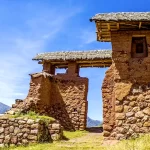
Adobe walls on stone foundations. This is the detail that surprises people who expect pure Inca stonework throughout. The lower courses are cut stone, Inca-style, but the upper walls were built in adobe, and what remains today is largely that adobe layer, weathered but still standing in sections.
Agricultural terraces (andenes). Stepped terraces descend from the main structures, following the same engineering logic as terracing elsewhere in the Sacred Valley, built to hold soil, manage water runoff, and grow crops at altitude.
An irrigation canal. A stone-lined channel that once carried water to the site and its terraces, still traceable along parts of its original route.
There’s no reconstruction here in the sense you’d see at more famous sites, no rebuilt roofs, no filled-in walls. What you’re looking at is largely what survived on its own.
Where It Is Exactly
Huchuy Qosqo sits above the town of Lamay, in the Sacred Valley, at roughly 3,650 m. That’s higher than Cusco itself, so the climb up matters more than the distance on a map suggests. From the site, the views open out over the Sacred Valley and the Urubamba River below, one of the better payoffs for the effort of getting there.
The site is protected as part of Peru’s archaeological heritage under the Ministerio de Cultura, which oversees conservation at Inca sites across the region.
How to Get There
There are two main ways in, and they’re genuinely different experiences, not just different starting points.
From Tambomachay. This is the classic route, starting near Cusco at the Tambomachay archaeological site and crossing high open country before descending into Huchuy Qosqo and on to Lamay. It’s a full trekking day, sometimes split into two, and it’s the version most operators, including us, build a proper itinerary around.
From Lamay. A shorter, steeper ascent directly up from the valley floor. It gets you to the site faster, but you skip the high-altitude walking and the sense of arriving at Huchuy Qosqo from above, which is part of what makes the Tambomachay route worth the extra time for most hikers.
We cover the site itself here; the trek is its own separate decision. Our 2-day Huchuy Qosqo trek guide walks through the classic route hour by hour, and if you’re deciding how much time to give it, our comparison of the 2-day and 3-day versions breaks down what the extra day actually adds. Our own itineraries follow that same split: the 2-day, 1-night Huchuy Qosqo trek and the 3-day, 2-night Huchuy Qosqo trek.
Why It’s Almost Empty
The main reason is bureaucratic, not a lack of interest. Huchuy Qosqo isn’t included in the standard Boleto Turístico (BTC), the multi-site ticket that covers Pisac, Ollantaytambo, and most of the sites travelers visit on a typical Sacred Valley day tour. If a site isn’t on that ticket and isn’t a stop on the regular Valle Sagrado bus circuit, most tour operators simply don’t build it into their standard itineraries. We explain exactly what the BTC does and doesn’t cover in our complete guide to the Cusco tourist ticket.
The altitude and the fact that reaching it requires an actual trek, rather than a bus stop and a short walk, filters out casual visitors too. It’s not hidden exactly, it’s on maps and in guidebooks, it’s just inconvenient enough that most people skip it in favor of sites that fit neatly into a single day.
What Pairs Well With a Visit
If you’re already trekking into the Sacred Valley for Huchuy Qosqo, it makes sense to build the rest of your Valle Sagrado time around it rather than treating it as an isolated day. Pisac, with its own hilltop ruins and busy market, is a natural companion, and our guide to the Pisac ruins covers what to expect there. For a wider view of what else the valley offers beyond the obvious stops, our roundup of essential Sacred Valley locations is a good starting point.
If you’re weighing Huchuy Qosqo against other multi-day treks in the region, particularly as an alternative to the crowded Inca Trail, our comparison between Huchuy Qosqo and the Short Inca Trail lays out the trade-offs directly, and our broader guide to alternative routes to Machu Picchu puts it in context with other less-crowded options.
Frequently Asked Questions
What is Huchuy Qosqo? Huchuy Qosqo was a royal Inca estate above the Sacred Valley, generally attributed to Wiracocha Inca. It combined a residence, ceremonial hall, and agricultural terraces, and its name, meaning “Little Cusco,” was applied later rather than being its original Inca name.
Is Huchuy Qosqo included in the Boleto Turístico? No, it’s not part of the standard Cusco tourist ticket that covers Pisac, Ollantaytambo, and other Sacred Valley sites. That’s one of the main reasons it sees so few visitors compared to sites on the regular circuit.
How do you get to Huchuy Qosqo? The classic route starts near Tambomachay outside Cusco and crosses high country before descending to the site and on to Lamay, usually as a full trekking day. A shorter, steeper option climbs directly up from Lamay in the valley below.
Is Huchuy Qosqo worth visiting? If you’re interested in Inca history without the crowds of the main circuit, yes. It has genuine architectural interest, an adobe kallanka, terracing, and a working sense of what a royal estate looked like, without the reconstruction seen at busier sites.
How high is Huchuy Qosqo? The site sits at roughly 3,650 m, higher than Cusco itself. It’s worth being acclimatized to Cusco’s altitude before attempting the trek, since the approach involves sustained walking at or above that elevation.
Can I visit Huchuy Qosqo without trekking? Reaching it always involves some walking, since it’s not accessible by road. The shorter ascent from Lamay is the least demanding option if a full trekking day isn’t practical for your itinerary.
What’s the difference between Huchuy Qosqo and Pisac? Pisac is on the standard tourist circuit, easily reached by road, and includes an active local market. Huchuy Qosqo requires a trek to reach, sees far fewer visitors, and preserves more of its original adobe architecture rather than reconstructed stonework.