Choose Salkantay if you want a high-altitude, physically demanding trek with glacier views, no permit restrictions, and the option to book on short notice. Choose Lares if you want lower daily mileage, more contact with Quechua-speaking communities, and you’re less concerned with reaching a dramatic 4,600+ m (15,000+ ft) pass.
Both end at Machu Picchu. Neither is the “easy” version of the other — they’re built around different priorities, and picking the wrong one for your fitness level or interests is the main reason people end up disappointed.
Salkantay is the better fit for most fit hikers who came to Peru for mountains. Lares is the better fit if the villages, textiles, and daily life along the route matter to you as much as the scenery. If you’re deciding between this and the classic Inca Trail, that’s a separate comparison — this article assumes you’ve already ruled that one out, usually because it sold out.


Lares vs Salkantay: Comparison Table
| Salkantay | Lares | |
|---|---|---|
| Typical duration | 4–5 days | 3–4 days |
| Max altitude | 4,630 m (15,190 ft) — Salkantay Pass | 4,800 m (15,748 ft) — Sicllaccasa Pass 4450 m (14,599 Ft) — Quiswarani → Condor Pass → Cuncani |
| Total distance | 70–74 km (43–46 miles) | 33–38 km (20.5–24 miles) |
| Difficulty | Challenging | Moderate to Challenging |
| Permits required | None | We can definitively confirm that our Lares Trek route does not require the strict, government-issued Inca Trail permits. |
| Ends with | Walk-in access to Machu Picchu via Hidroelectrica/Aguas Calientes | Train from Ollantaytambo to Aguas Calientes |
| Crowds | Moderate, busiest June–August | Lighter — Lares still sees far fewer trekkers than Salkantay |
| Approx. cost | Approximate from $550 to $650 USD | Approximate from $550 to $650 USD |
Both routes skip the Inca Trail’s permit system and daily hiker cap, so on both, availability is rarely the reason to book early. Cost, dates, and physical readiness usually are.
The Differences That Actually Matter
Altitude and physical demand
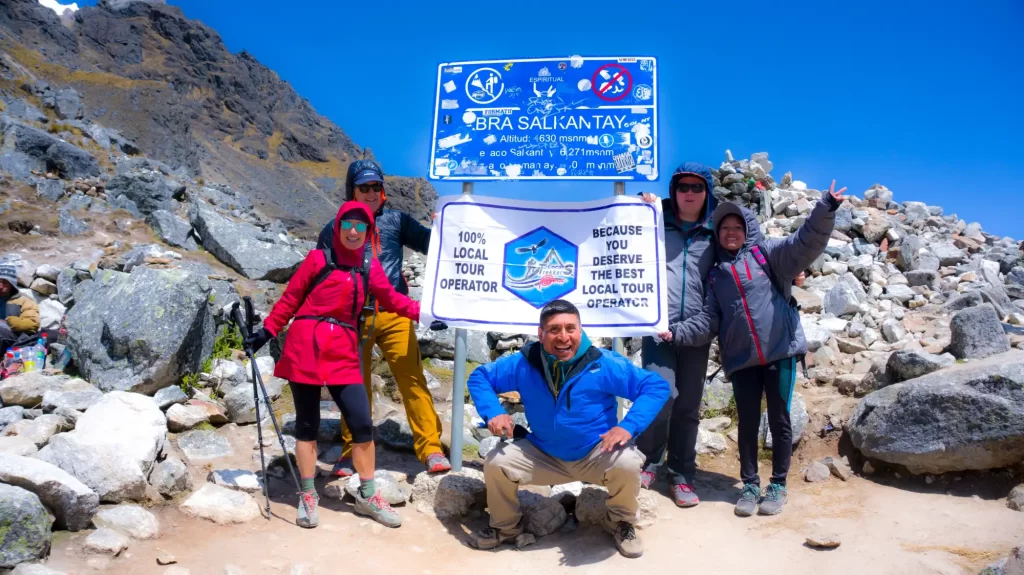
Salkantay’s pass sits at 4,630 m (15,190 ft), reached after a steep, sustained climb from Soraypampa camp at 3,900 m (12,795 ft). You’re also covering more ground — 70–74 km (43–46 miles) over the full route — with one demanding high-altitude day at the center of the trek.
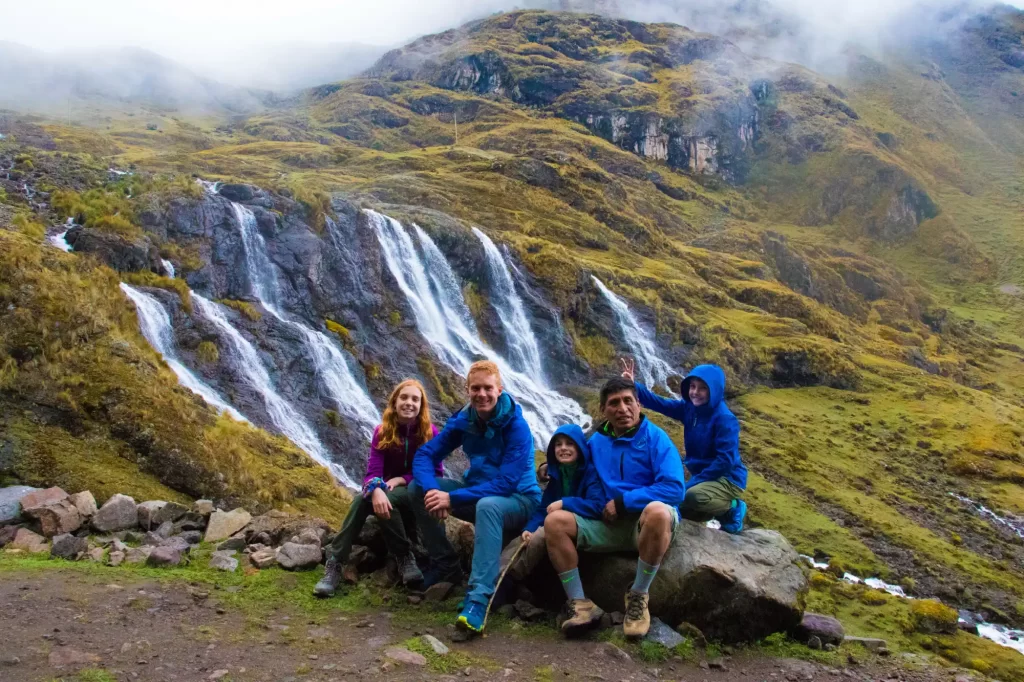
Lares reaches a higher single point, 4,800 m (15,748 ft) at the Sicllaccasa Pass, but the daily distances are shorter and the itinerary is generally paced to spend less consecutive time above 4,000 m (13,120 ft). That makes Lares feel less punishing overall, even with a higher top altitude, because you’re not stacking long mileage on top of thin air.
If your training has been inconsistent, or you’ve never hiked above 3,000 m (9,840 ft) before, Lares’ shorter daily stages are more forgiving. Salkantay rewards people who’ve done multi-day hikes at elevation before.
Landscape: glaciers vs villages
Salkantay’s core selling point is the transition from snow and glacier at the pass down into cloud forest within the same day — you go from wearing a down jacket to sweating in a t-shirt in a matter of hours. Mount Salkantay itself, at 6,271 m (20,574 ft), dominates the skyline for most of the trek.
Lares runs through inhabited Andean valleys the whole way. You pass through communities where Quechua is the first language, see alpaca herds working land that’s been farmed the same way for generations, and the trail itself is more about the people living alongside it than about a single dramatic summit view.
Neither is more “authentic” than the other — they’re just pointed at different things. Salkantay is a nature-and-endurance trek. Lares is a cultural-immersion trek that happens to cross a high pass.
Hot springs and the small stuff
Salkantay includes a stop at the Cocalmayo hot springs on the descent into the lower valley — a genuine highlight after two cold nights at altitude, and something Lares doesn’t have built into most itineraries.
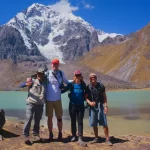
Salkantay also passes Humantay Lake, a turquoise glacial lake at 4,120 m (13,517 ft) that’s become one of the most photographed spots in the region on its own. Lares doesn’t have an equivalent single “wow” stop — its highlights are distributed across the villages rather than concentrated at one viewpoint.
How you finish the trek
This is the difference people underestimate. Salkantay typically ends with a walk to Hidroelectrica and then along the rail line into Aguas Calientes — a long, flat final stretch that some trekkers find anticlimactic after the mountain days. Lares connects to the train from Ollantaytambo, which is a shorter, more comfortable finish but adds a fixed train schedule to your itinerary.
On day three of our Lares Trek, we transition from the trail to the Sacred Valley, heading to Ollantaytambo to catch the train to Aguas Calientes. We secure tickets for the comfortable Inca Rail Voyager or PeruRail Expedition trains, typically booking the 16:36 or 19:04 departures.
We intentionally avoid early afternoon trains to ensure our trekkers never feel rushed during the final hiking descent or while enjoying a well-deserved lunch. This schedule gives our groups plenty of time to explore Ollantaytambo’s cobblestone streets or relax with a coffee before boarding.
For trekkers looking for a premium experience with panoramic views, we gladly arrange upgrades to the Vistadome train upon request at the time of booking.
What you’ll actually pack differently
The core kit list overlaps almost entirely — a 4-season sleeping bag, thermal base layers, waterproof boots, trekking poles, and strong sun protection are non-negotiable on both routes. The difference is in what you use daily versus what stays in your duffel.
On Salkantay, you wear your warmest layers every morning near the pass and strip down to a t-shirt by afternoon as you drop into the cloud forest — pack for that swing specifically, not for one climate. On Lares, temperature swings are real but less extreme day to day, since you’re not descending into humid jungle terrain. What matters more on Lares is having something reasonable to wear if you’re invited into a community home or a weaving demonstration — nothing formal, just not your most worn-out trail clothes.
Group size and pace
Salkantay departures tend to run larger during June–August simply because demand is higher. Lares groups tend to stay smaller across the season, partly because fewer operators run it as a flagship product.
There is a distinct difference in the day-to-day atmosphere between these two routes, largely driven by group sizes. Our Salkantay departures are our most popular alternative treks, typically running with 6 to 8 trekkers and capped at 10 during the peak dry season.
In contrast, the Lares Trek offers a much more intimate, off-the-beaten-path experience. Our Lares departures frequently operate with just 2 to 5 trekkers, strictly capped at 8. Because the Lares route focuses heavily on cultural immersion in remote Quechua-speaking communities, maintaining a smaller footprint is essential.
This smaller group size allows our guides to facilitate genuine interactions with local weavers and farmers, ensuring a deeply personal and quiet journey through the Andean highlands.
Cost and what you’re actually paying for
Salkantay generally costs less than the Inca Trail because there’s no permit fee built into the price — the same is true for Lares. Where Salkantay and Lares differ from each other usually comes down to trek length, group size, and whether horses or porters are included for your gear.
I have just verified the live 2026/2027 pricing on our booking platform for our standard small-group departures. For the classic 4-day Lares Trek, the current rate sits exactly at $590 USD per person.
For our comprehensive Salkantay Trek, pricing currently ranges from $550 to $650 USD per person, depending on whether trekkers choose the 4-day express or the 5-day classic route, as well as any specific dome or hotel upgrades in Aguas Calientes.
Both of these standard rates fully cover all essential ground logistics—including private transport, our expert guiding team, high-quality four-season camping gear, a dedicated chef, and Machu Picchu entrance tickets.
It is good practice to remind readers that these base rates apply to our shared group departures (capped at 8 to 10 trekkers) and, per company policy, do not include domestic or international airfare.
Don’t assume the shorter Lares itinerary is automatically cheaper. Check the actual quote, since inclusions vary by operator and by route.
Which to Choose for Your Case
You’re an experienced hiker who wants a physical challenge
Pick Salkantay. The combination of distance, altitude gain, and glacier exposure is the closer thing to a genuine mountaineering-adjacent experience on this list of routes. Our 4-day Salkantay Trek to Machu Picchu covers the full route, including the pass and Humantay Lake.
You care more about culture and people than summit views
Pick Lares. If interacting with weaving communities and seeing daily Andean life matters more to you than a glacier pass, Salkantay’s landscape won’t compensate for what Lares offers here.
For full day-by-day itinerary details, an interactive route map, and upcoming availability, you can review everything directly on our official website. We encourage you to visit our dedicated Lares Trek Tour Page to explore the specific camping locations, meal plans, and what you need to pack.
On the page, you can also easily process your reservation through our secure booking system. If you have any specific requirements, such as dietary restrictions or requests for private tent upgrades, our operations team is available via the contact form on that page to tailor the trek exactly to your needs before you finalize your travel dates.
You’re not sure your fitness level is up to either
Talk to us before booking rather than guessing. Neither route should be your first multi-day hike at altitude, and if you have any underlying health concerns, check with a travel clinic before committing to either — this isn’t something a blog article can safely advise you on.
You want to do both
Some travelers split a longer Cusco trip and do Lares as a shorter warm-up before a bigger trek, or add it as a separate short excursion.
While both the Lares and Salkantay treks are phenomenal experiences, we operate them as two entirely separate bookings rather than a single combined itinerary.
Logistically, these routes explore opposite sides of the region—Lares dives into the cultural heart of the Sacred Valley to the northeast, while Salkantay navigates the rugged alpine environments and cloud forests to the northwest. Attempting to link them back-to-back without rest would be physically exhausting and require unnecessary backtracking to Cusco.
For trekkers wanting to experience both distinct environments, we recommend booking them as separate tours with at least two or three days of recovery in Cusco in between.
FAQs
Is Lares or Salkantay harder? Salkantay is harder overall — more distance, more sustained altitude exposure, and a tougher single pass day. Lares is still a real trek, not a walk, but its shorter daily stages make it the more manageable option physically.
Do I need a permit for Lares or Salkantay? Neither requires the Inca Trail permit.
Yes, the flexibility and permit-free nature of the trek applies without exception to all of our Lares route variants. However, because this trek relies on access through private, indigenous community lands rather than state-run parks, we maintain strict, respectful agreements with the local villages we pass through, such as Huacahuasi and Patacancha.
There are no rigid government restrictions, but we strictly adhere to community guidelines regarding camping zones, waste management, and photography. Our operations team works directly with local leaders year-round to ensure our presence brings positive economic impact without disruption.
As long as trekkers follow the guidance of their lead guide regarding cultural etiquette, the entire route remains fully accessible and completely flexible to our operational scheduling.
Which trek has better views of Machu Picchu itself? Neither route delivers a dramatically different final view of the citadel — both connect through Aguas Calientes before the standard entrance. The views that differ are along the trail itself, not at the destination.
Can beginners do either trek? Fit beginners with no altitude experience generally handle Lares better than Salkantay. Acclimatizing for 2–3 full days in Cusco at 3,400 m (11,150 ft) beforehand matters for both routes, regardless of fitness level.
Is one trek cheaper than the other? Our pricing for both the Salkantay and Lares treks reflects a fully transparent structure tailored to group size, itinerary length (such as 4-day vs. 5-day options), and seasonal demand.
Generally, classic small-group departures range between $550 and $650 USD per person. However, rates dynamically adjust depending on whether you join a standard group or opt for a customized private service, as well as optional additions like train class upgrades or private hotel accommodations in Aguas Calientes.
In accordance with company policy, all our packages cover comprehensive ground operations—including experienced local guides, high-grade four-season camping equipment, chef services, and entrance permits—while strictly excluding domestic or international flights.
To ensure precise budgeting for your specific dates and group configuration, we always advise verifying current live rates directly on our official tour pages prior to publishing.
For the full breakdown of the Salkantay route — day-by-day distances, altitude profile, and what to expect — see our Salkantay Trek: The Complete Guide. If your dates are flexible, our guide to the best time to do the Salkantay trek covers month-by-month weather and crowd levels in more detail than the table above.